


Department of Anthropology
Assistant Professor
216 Waldo Hall
541/737-3849
Email: loren.davis@oregonstate.edu
| Ph.D. |
Anthropology, University of Alberta,
Edmonton, Canada |
2001 |
| M.A.I.S. |
Anthropology, Geography, Soil Science,
Oregon State University |
1995 |
| B.Sc. |
Anthropology, Oregon State University |
1991 |
Research
Far Western Prehistory
While I have experience working on archaeological sites of all ages, I am mainly interested in the early record (pre-8,000 BP) of hunter-gatherers in western North America.
Lower Salmon River Canyon
Between 1997-2007 I directed research at several sites in the Lower Salmon River Canyon of west-central Idaho; many of which produced early cultural occupation. Most notably, reinvestigation of the Cooper's Ferry site (10IH73) resulted in the discovery of a cache of stemmed points and lithic tools, which have been dated between 11,410-11,370 BP. This find represents the only chronometrically-dated equipment cache in the Far West and adds new information about the antiquity of western stemmed projectile point technology.
Other work with early sites has allowed me to explore issues relating to early cultural ecology and economic organization under changing environmental conditions of the late Pleistocene and early Holocene. Recent geoarchaeological work in the lower Salmon River canyon with the Idaho BLM can be found at http://www.blm.gov/id/st/en/fo/cottonwood/lower_salmon_river.3.html
Southern Oregon Coast
In the summer of 2000 I began work on a research project with Roberta Hall to find and investigate pre-8,000 BP sites on the southern Oregon coast. Using a systematic geoarchaeological approach we have worked to define the distribution and character of late Pleistocene to early Holocene landforms along the coast.
Research Design for the Oregon Paleocoastal Survey
Research Problem
The Oregon Coast has experienced a great degree of environmental change over the past 12,000 years. During this period between ca. 12,000-6,000 years ago sea level rose more than 180 feet in response to postglacial environmental change. As sea levels rose, natural systems along the coast adjusted to this marine transgression, leaving behind geologic deposits to mark the timing and manner of their changes. Humans have lived in the coastal landscape throughout this period of postglacial environmental change and left behind material evidence that forms the archaeological record. Evidence of human occupation predating the arrival of modern sea level 6,000 year ago is difficult to find as natural systems destroyed, obscured, or otherwise limited the visibility of early archaeological sites along the coast.
Methodological Approach
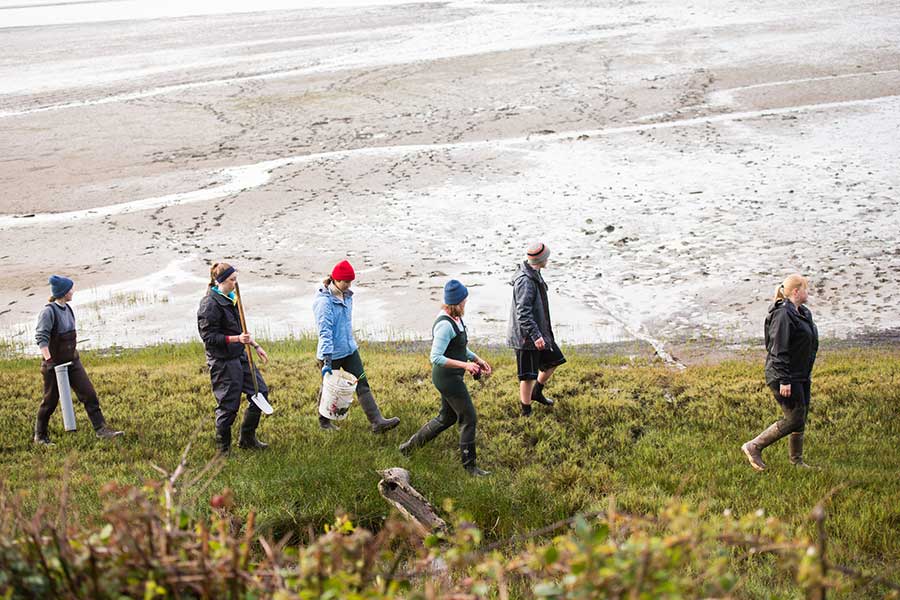
Traditionally, archaeologists seek to find evidence of past human occupation by walking across landforms, attempting to find artifacts and features from the past. OSU archaeologists have succeeded in finding early sites along the Oregon coast by using a geoarchaeological method based on the application of earth science principles. This geoarchaeological method seeks to find geologic layers of particular ages that might represent pieces of ancient landscapes attractive to prehistoric coastal peoples. Today, the western edge of Oregon's coastline presents an extensive natural exposure that reveals a layered sequence of sediments and soils. By studying the physical and geochemical qualities and ages of these layered sequences we can build a geoarchaeological framework for understanding the timing and manner of landscape change and the potential that each layer might have for retaining previously unknown evidence of prehistoric occupation.
Data will be gathered from naturally available and minimally prepared stratigraphic profiles that exist along the coastal margin of Oregon State Parks. If needed, profiles will be cleaned to expose fresh surfaces by scraping with trowels and shovels, removing only a few centimeters (< 5 cm) of weathered materials. Scraped sediments will be screened through 1/8" mesh. Stratigraphic information will be collected through photography and the preparation of drawings and descriptions. Stratigraphic descriptions will be made in accordance with conceptual nomenclature of the North American Stratigraphic Code and the USDA Soil Survey Manual. Following recordation, one liter bulk samples will be collected from representative stratigraphic units. Selected samples of datable materials will be collected, where available. Samples will be subjected to a range of analytical procedures to evaluate properties including, but not limited to, sedimentology, mineralogy, pedology, paleovegetation, and chronology.
Anticipated Results
Because this project represents a new and novel direction toward the generation of knowledge on contextual aspects of Oregon coastal archaeology, we cannot be certain of the exact results of our efforts. Nevertheless, Oregon coastal geology covering the last 12,000 years is poorly understood. Because of this, any discoveries we make in the process of this proposed work will be valuable, if for nothing else than for the accumulation of information on the nature of coastal environments and their change through time. It is highly anticipated that this proposed research will reveal the distribution of archaeologically relevant geologic units that hold previously unknown buried cultural components. Because they would serve to identify the location of otherwise difficult to find cultural components, these geoarchaeological discoveries will greatly advance the state of knowledge on the early prehistory of the Oregon coast.
Benefit
As a part of this survey, OSU students will learn practical skills related to standardized methods of stratigraphic recordation, sampling procedures for various laboratory analyses, and approaches to the interpretation of past depositional environments. The larger goal of the survey is to construct a detailed knowledge of landscape evolution and buried archaeological site potential in the modern coastal landscape. This geoarchaeological database will contribute valuable information to be shared by the archaeological community and can help agencies and tribal groups make better decisions about how to manage their cultural resources held in the coastal landscape.
Prehistory and Cultural Ecology of Baja California, Mexico
Baja California possesses some of the greatest ecological diversity on the planet. Along a narrow latitudinal transect, one moves from the semi-arid Pacific coastal plain, to the hyper-arid desert interior basins with their flanking high-altitude alpine ecosystems, to the desert shores of the biotically-rich Sea of Cortez. How hunter-gatherers lived within this unique region is known from ethnographic and historic accounts. A deeper temporal perspective is largely absent in much of the region, due to the paucity of intensive archaeological investigations. Since 1996, I have led multiple archaeological and geoarchaeological investigations to pursue several goals, including: understanding cultural adaptation in the extremely arid and ecologically-diverse environments of the peninsula; exploring the prehistory and cultural ecology the late Pleistocene to early Holocene period; and elucidating the record of middle Holocene adaptations during the onset of extreme aridity. The results of this work are actively shaping archaeological perspectives on this poorly-understood region. To learn more about anthropological and archaeological research in Baja California visit: http://pweb.jps.net/%7Edlaylander/
Publications
- Davis, Loren G., Roberta A. Hall, Samuel C. Willis. Response to Moss Et Al. "An Early Holocene/Late Pleistocene Arcaheological Site on the Oregon Coast? Comments on Hall Et Al (2005)" Radiocarbon, 45(3): 469-472. 2006
- Michele L. Punke and Loren G. Davis. Problems and Prospects in the Preservation of Late Pleistocene Cultural Sites in Southern Oregon Coastal River Valleys: Implications for Evaluating Coastal Migration Routes. Geoarchaeology: An International Journal 21(4): 333-350.
- Davis, Loren G. Geoarchaeological Insights from Indian Sands, a Late Pleistocene Site on the Southern Northwest Coast, USA. Geoarchaeology: An International Journal 21(4): 351-361. 2006
- Davis, Loren G. Paleoenvironmental context. Accepted for publication in, Laylander and Moore (eds.), Prehistory of Baja California: Advances in the Archaeology of the Forgotten Peninsula, to be published by the University Press of Florida. 2005
- Davis, Loren G. Geoarchaeological lessons from an alluvial fan in the lower Salmon River canyon. Accepted for publication in Idaho Archaeologist. 2005
- Davis, Loren G. and Charles E. Schweger. Geoarchaeological context of late Pleistocene and early Holocene occupation at the Cooper's Ferry site, western Idaho, USA. Geoarchaeology: An International Journal 19(7): 685-704. 2004
- Davis, Loren G., Michele L. Punke, Roberta L. Hall, Matthew Fillmore, and Samuel C. Willis. A Late Pleistocene Occupation on the Southern Coast of Oregon. Journal of Field Archaeology 29(1):7-16. 2004
- Hall, Roberta L., Loren G. Davis, and Michele L. Punke. A late Pleistocene site on Oregon's southern coast. The Midden 35(1):5-8. 2003
- Hall, Roberta L. and Loren G. Davis. Locating Sites of the Pleistocene-Holocene Transition on Oregon's Southern Coast. Current Archaeological Happenings in Oregon 27(3-4):7-11. 2003
- Davis, Loren G. Geoarchaeology and Geochronology of Pluvial Lake Chapala, Baja California, Mexico in Geoarchaeology: An International Journal 18(2). 2002.
- Davis, Loren G. Bibliography of Baja California Geoarchaeology. Annotated and detailed thematic geology and archaeological geology reference list posted at http://www.bajacalifologia.org/english/index.htm. 2002.
- Davis, Loren G., K. Muehlenbachs, C.E. Schweger, and N.W. Rutter. Differential Response of Vegetation to Postglacial Climate in the Lower Salmon River Canyon, Idaho in Palaeogeography, Palaeoclimatology, Palaeoecology 2894:1-16. 2002.
-
- Davis, Loren G. and Karlis Muehlenbachs. A Late Pleistocene to Early Holocene Record of Precipitation Reflected in Margaritifera falcata Shell
d18O From Three Archaeological Sites in the Lower Salmon River Canyon, Idaho in Journal of Archaeological Science 28:291-303. 2001.
- Davis, Loren G. The Coevolution of Early Hunter-Gatherer Culture and Riparian Ecosystems in the Southern Columbia River Plateau, Ph.D. Dissertation, University of Alberta, Department of Anthropology and Department of Earth and Atmospheric Sciences. 2001.
- Davis, Loren G. Cascade in, Encyclopedia of Prehistory, Volume 6: North America. pp. 27-30, P. Peregrine and M. Ember (eds.), Kluwer Academic/Plenum Publishers, New York. 2001.
- Davis, Loren G. and David A. Sisson. An Early Stemmed Point Cache from the Lower Salmon River Canyon of West-Central Idaho, Current Research in the Pleistocene Vol. 15. Center for the Study of the First Americans, Corvallis, Oregon. 1998.
A brief word on graduate students and graduate studies:
Graduate studies in archaeology are a requisite step toward achieving greater levels of responsibility and intellectual productivity. Just as you would not attend a culinary arts school or a plumbing trade school to improve your education in archaeology, prospective graduate students should not take lightly their decision to attend a particular university without first considering the institution's available resources. First, and most important, prospective graduate students need to find an advisor who is currently working on research projects that not only stimulate their interests but represent the kind of work they themselves would like to pursue. If you are interested in the archaeology of the Maya, then by all means, find an advisor who is actively working on a particular aspect of Mayan archaeology that stimulates your desire to pursue an advanced education. Serious problems often arise when students make decisions to attend a graduate program mainly on the basis of geography, i.e., closeness to home, family, friends, significant other, without serious consideration of whether the graduate program actually offers the resources and advisors you need to realize your educational goals. So, before you make an application for graduate school at OSU or anywhere else for that matter, do your homework: read up on the kind of research a prospective advisor has worked on and is currently pursuing; think about how your interests match up with that prospective advisor¹s; work to clearly and thoughtfully articulate how your own educational and research interests might be best realized through studies at that institution, with that particular person.
The bottom line:
My graduate students work with me in the field and in the lab, mainly pursuing research questions related to the archaeology and/or geoarchaeology of the lower Salmon River canyon of western Idaho, the Oregon coast, and the Baja California peninsula. There are many kinds of research opportunities, tied to quality datasets, within each of these research areas. I fully expect that each of my graduate students will develop and pursue original research problems on a site, locality, or collection from one of my study areas. To me, the benefits of this approach are clear: students will receive hands-on training on a project that I know a great deal about; the logistical and bureaucratic aspects of the project are fully supported; students gain access to rich datasets associated with the study areas; projects in these areas are well funded. That a student would want to attend OSU to work with me to pursue a project I know nothing makes things difficult for the student and for me. More importantly, the advisor-student relationship is rendered ineffective in these situations, seriously diminishing the student's graduate experience.
Research Links
Geological Society of America's Archaeological Geology Division:
http://rock.geosociety.org/arch/
Society for American Archaeology's Geoarchaeology Interest Group:
http://www.saa.org/aboutSAA/interestGroups/geoArch/
American Quaternary Association:
http://www.amqua.org/