

News aggregator
US Fulbright Information Session
The Fulbright U.S. Student Program is the largest U.S. exchange program offering opportunities for students and young professionals to undertake international graduate study, advanced research, university teaching, and primary and secondary school teaching worldwide. The program currently awards approximately 1,800 grants annually in all fields of study, and operates in more than 155 countries worldwide.
During their grants, Fulbrighters will meet, work, live with and learn from the people of the host country, sharing daily experiences. The program facilitates cultural exchange through direct interaction on an individual basis in the classroom, field, home, and in routine tasks, allowing the grantee to gain an appreciation of others’ viewpoints and beliefs, the way they do things, and the way they think. Through engagement in the community, the individual will interact with their hosts on a one-to-one basis in an atmosphere of openness, academic integrity, and intellectual freedom, thereby promoting mutual understanding.
GE Spring Session 2 Ends
Pathway Programs Spring Term Ends
AE Summer Term Orientation
GE Summer Session 1 Orientation
Pathway Programs Summer Term Begins
GE Summer Session 1 Begins
Independence Day
The office of International Degree & Education Aborad (IDEA) will be closed in accordance with the OSU holiday schedule.
If there is an emergency, please contact OSU Public Safety at 541.737.7000.
GE Summer Session 2 Orientation
GE Summer Session 2 Begins
OSU Advantage: Sustainable Semis
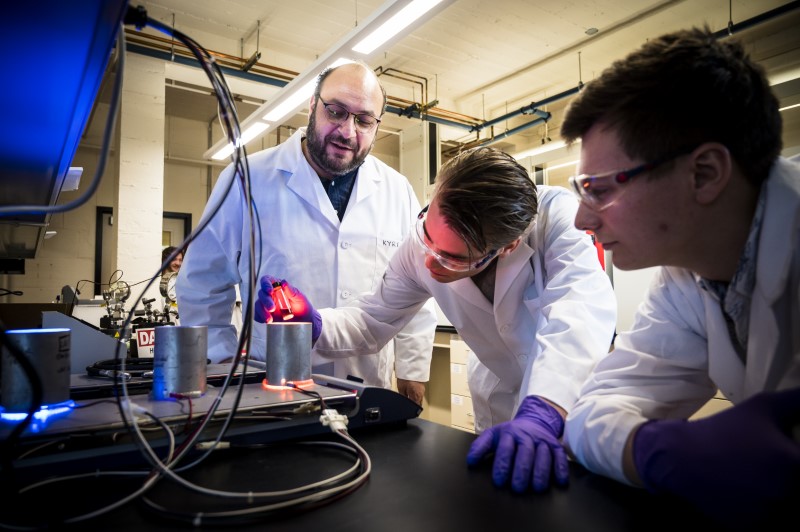
Like the auto industry, trucking companies are looking for new ways to cut fuel consumption and greenhouse gas emissions. A partnership between Oregon State University and Daimler Trucks North America is making inroads by developing an 18-wheeler that combines high strength for heavy payloads and increased fuel efficiency for sustainable performance.
Part of the Super Truck program funded by the U.S. Department of Energy and Daimler, this effort already has yielded promising early results: a prototype carbon-fiber chassis rail and an innovative design for cruise control. The partnership began in 2009 when Daimler contacted John Parmigiani, a research assistant professor in Oregon State’s School of Mechanical, Industrial and Manufacturing Engineering (MIME), seeking ideas. Daimler is the leading commercial truck manufacturer in North America.
Parmigiani led a research project to replace the rails, key chassis components that run from front to back, with lighter materials. By using carbon fiber — the same material used for rocket nose cones — instead of steel, Daimler achieved significant weight reduction.
“Carbon fiber is a great material to use. The weight difference is amazing.”
— John Parmigiani
The partnership with Oregon State was a positive experience, says Derek Rotz, a senior manager in advanced engineering for Daimler — so positive, in fact, that the company hired Brian Benson, one of the graduate students who worked on the project.
“We learned a lot about the design,” Rotz adds. “There still needs to be more work done before we put the carbon fiber rails into mass production, because they are more expensive.”
The next step will be to integrate the rails into a production prototype. Headquartered in Portland, Daimler Trucks North America manufactured 141,000 vehicles in 2012. Its brands include Freightliner, Western Star, Freightliner Custom Chassis, Thomas Built Buses and Detroit.
In a separate project, MIME professor Kagan Tumer used “intelligent systems” to create an adaptive cruise control that improves fuel efficiency.
_____________________
THE OREGON STATE UNIVERSITY ADVANTAGE delivers bottom-line benefits for business through access to career-ready graduates and world-class research. To discover what the Venture Accelerator and the Industry Partnership Program can do for your business, contact Ron Adams, Executive Associate Vice President for Research, Oregon State University, A312 Kerr Administration Building, Corvallis, OR 97331, 541-737-7722.
From Data to Doing
Adapting to climate change requires two key things: good data and boots on the ground. As oceans rise, icecaps melt, snowpack diminishes, wildfires rage and aquifers dry up, coupling science to action becomes ever more urgent. But the barriers to linking science to practical action are formidable, often springing from deep disparities in worldview among researchers and “information users,” says Oregon State sociologist Denise Lach. Scientists and decision makers, she notes, may hold “different notions of truth and knowledge.”
Breaking through these barriers is the intent behind a pilot project in Idaho’s Big Wood River Basin, where a diverse group of local stakeholders has been meeting regularly with OSU climate and social scientists to talk about and plan for climate-driven changes in water quality and availability. Convening and hosting this “knowledge-to-action network” is the Climate Impacts Research Consortium (CIRC) based at Oregon State. By fall, the network will have developed and analyzed alternative scenarios based on climate models, land-use practices and population growth.
Sea Trio
Over the next 10 years, Oregon State University will be at the forefront of a ship building project that will “revitalize and transform” coastal-ocean science in the United States, says oceanographer and former U.S. Navy and NOAA administrator Rick Spinrad, the university’s vice president of research. OSU has been designated as the lead institution for the design, building and launching of as many as three state-of-the-art research vessels funded by the National Science Foundation.
Officials expect the vessels to be positioned on the East Coast, the West Coast and the Gulf Coast, depending on research needs and available funds. The 175-foot vessels will be “floating, multi-use laboratories” that are “more seaworthy and environmentally green” than previous research vessels, says Mark Abbott, dean of the College of Earth, Ocean, and Atmospheric Sciences. The first ship will hit the water in 2019 or 2020.
Grape Crush
As you sip your favorite Oregon wine, do you ever wonder what happened to the discarded remains of those luscious grapes? Typically, the seeds, skins and stems from the nation’s 4 million tons of wine grapes have been tossed out — until now.
The pulpy leftovers of juicing and crushing, called “pomace,” are finding their way into products as diverse as gluten-free muffins, biodegradable flowerpots and edible food wrappings, thanks to Oregon State Extension researcher Yanyun Zhao and cereal chemist Andrew Ross. Loaded with antioxidants and dietary fiber, pomace also controls bacteria and preserves fats, making it versatile as well as nutritious.
“We now know that pomace can be a sustainable source of material for a wide range of goods,” says Zhao.
Flight Plan
Unmanned aerial vehicles (UAVs), sometimes referred to as “drones,” have been the focus of recent international attention because of their military use. However, these systems also have many domestic uses that are practical and benign and should be embraced for their potential to save money and lives.
UAVs are an emerging industry that Oregon can help lead, and the state would be wise to support it. Oregon State University has formed a consortium with industry, government and others to develop the use of these aerial systems, a potential multi-billion dollar job growth engine that will also provide significant benefits to society.
Under a mandate from Congress, the Federal Aviation Administration will establish several test sites for UAVs by 2015, and one of those sites could be in Oregon. Our state offers a unique combination of research excellence, varied terrain, relevant industry and local applications in agriculture and forestry.
There’s not much that UAVs can do that a pilot in a small plane couldn’t do, but they can do it more safely and at much lower cost. UAVs can monitor and help manage wildfires or support a search and rescue mission. They can help forest-product industries plant trees to avoid wind or heat damage. They can monitor wildlife, improve irrigation, detect crop-disease outbreaks and gauge environmental health.
Decades of experience in remote sensing have drawn OSU to this venture. Our oceanographers use NASA satellites to monitor global phytoplankton productivity and identify harmful algal blooms. We use optical remote sensing to detect earthquake faults, assess wildfire impacts on forests and measure tsunami inundation patterns. We have instruments on the International Space Station to study shoals and ocean shores.
Natural Extension
We have already formed the OSU Unmanned Vehicle System Research Consortium to bring a national UAV test center to Oregon. The business and job potential is high. With more than 300 companies and nearly 7,000 employees, Oregon’s aviation sector sees UAV technology as a natural extension of industry within our state that already is building helicopters, small aircraft and aviation components. OSU and industry partners n-Link and Prioria have conducted the state’s first FAA-sanctioned mission – a UAV flight over McDonald Forest near Corvallis that provided live video of the research forest.
We recognize that the transition toward the civilian benefits of UAVs has raised privacy concerns. Protection from prying cameras where there is a reasonable expectation of privacy is a legitimate concern, legally protected by current law and the Fourth Amendment of the U.S. Constitution.
Every new technology raises some kind of social concern, and society figures out reasonable solutions. We urge that these solutions be pursued in parallel with the needed technical research as the FAA develops a comprehensive privacy policy.
This technology will be developed somewhere in the United States. Because of Oregon’s comprehensive scientific and industry experience, and our state’s ideal geography, we can choose to be a leader in this exciting venture. That choice would be good for Oregon business, industry, researchers, workers and our environment.
Freedom of Access
The widespread availability of knowledge is a key element of Oregon State’s land grant mission. Since 2006, OSU Libraries and Press has maintained a publicly available repository (ScholarsArchive@OSU) of scientific papers and student theses and dissertations. This archive — and ones like it at other universities — could be a cost-effective solution for a new federal initiative to make more research information available to the public.
Traditional channels of scholarly publication preclude access by the general public who, in the case of state and federally funded research, paid the bills. Journals that charge an annual subscription fee restrict information to those who are affiliated with institutions that can pay the fee. Costs vary widely but can be as much as $20,000 a year or more.
Recognizing the continued role of publishers and the need to facilitate public access, the White House Office of Science and Technology Policy (OSTP) issued a policy memorandum on February 22. It directs federal agencies with more than $100 million in annual research and development expenditures to work with stakeholders to make articles and research data associated with federally funded research freely available to the public within 12 months of publication.
The OSTP policy directive is a significant milestone for public access to scholarship. It benefits OSU researchers by increasing the readership and impact of their scholarship. It also provides accountability to the public by enhancing access to the scholarship they funded.
In fiscal year 2012, OSU researchers received more than $176 million in funding from federal agencies. What the OSTP directive means for these scientists will depend on agency requirements still in development, but the existing National Institutes of Health (NIH) public access policy may serve as a model to other agencies. The NIH requires articles that result from NIH funding to be available in the freely accessible PubMed Central database within 12 months of publication. While individual agencies are charged with developing policies, the memorandum does encourage interagency cooperation in order to make the processes and, potentially, the systems uniform.
ScholarsArchive@OSU already provides access to thousands of faculty and student articles and was recently ranked seventh among U.S. single institution repositories. The use of institutional repositories to preserve and make federally funded research available to the public has several benefits. It leverages infrastructure that is largely in place, and it enables institutions to monitor and ensure policy compliance for their own authors.
For scholars, access to the work of their peers is fundamental to the advancement of research. Making well-organized research data more widely available encourages reuse and supports inter- and intra-disciplinary collaboration. It also enables the private sector to leverage public research and invest in and develop new products and services.
Last year, the National Science Foundation began requiring the inclusion of data management plans as part of grant proposals. The Oregon State University Libraries and Press supports OSU faculty in meeting this and other federal data requirements. Our services are likely to evolve to support new agency requirements that result from the directive.
_____________________________
Editor’s note: Michael Boock is head of Oregon State’s Center for Digital Scholarship and and associate professor with OSU Libraries and Press