


OSU's Global Impact
OSU Advantage: Sustainable Semis
Illustration by Leslie Herman
Like the auto industry, trucking companies are looking for new ways to cut fuel consumption and greenhouse gas emissions. A partnership between Oregon State University and Daimler Trucks North America is making inroads by developing an 18-wheeler that combines high strength for heavy payloads and increased fuel efficiency for sustainable performance.
Part of the Super Truck program funded by the U.S. Department of Energy and Daimler, this effort already has yielded promising early results: a prototype carbon-fiber chassis rail and an innovative design for cruise control. The partnership began in 2009 when Daimler contacted John Parmigiani, a research assistant professor in Oregon State’s School of Mechanical, Industrial and Manufacturing Engineering (MIME), seeking ideas. Daimler is the leading commercial truck manufacturer in North America.
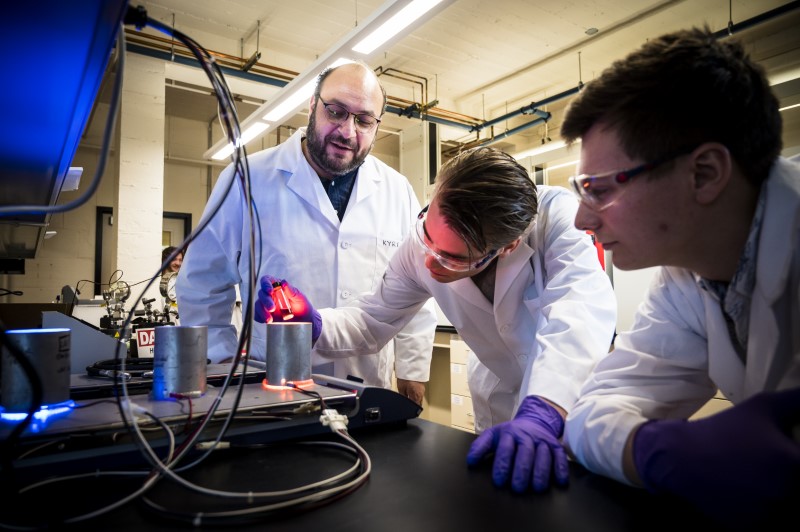
Parmigiani led a research project to replace the rails, key chassis components that run from front to back, with lighter materials. By using carbon fiber — the same material used for rocket nose cones — instead of steel, Daimler achieved significant weight reduction.
“Carbon fiber is a great material to use. The weight difference is amazing.”
— John Parmigiani
The partnership with Oregon State was a positive experience, says Derek Rotz, a senior manager in advanced engineering for Daimler — so positive, in fact, that the company hired Brian Benson, one of the graduate students who worked on the project.
“We learned a lot about the design,” Rotz adds. “There still needs to be more work done before we put the carbon fiber rails into mass production, because they are more expensive.”
The next step will be to integrate the rails into a production prototype. Headquartered in Portland, Daimler Trucks North America manufactured 141,000 vehicles in 2012. Its brands include Freightliner, Western Star, Freightliner Custom Chassis, Thomas Built Buses and Detroit.
In a separate project, MIME professor Kagan Tumer used “intelligent systems” to create an adaptive cruise control that improves fuel efficiency.
_____________________
THE OREGON STATE UNIVERSITY ADVANTAGE delivers bottom-line benefits for business through access to career-ready graduates and world-class research. To discover what the Venture Accelerator and the Industry Partnership Program can do for your business, contact Ron Adams, Executive Associate Vice President for Research, Oregon State University, A312 Kerr Administration Building, Corvallis, OR 97331, 541-737-7722.
From Data to Doing
Adapting to climate change requires two key things: good data and boots on the ground. As oceans rise, icecaps melt, snowpack diminishes, wildfires rage and aquifers dry up, coupling science to action becomes ever more urgent. But the barriers to linking science to practical action are formidable, often springing from deep disparities in worldview among researchers and “information users,” says Oregon State sociologist Denise Lach. Scientists and decision makers, she notes, may hold “different notions of truth and knowledge.”
Breaking through these barriers is the intent behind a pilot project in Idaho’s Big Wood River Basin, where a diverse group of local stakeholders has been meeting regularly with OSU climate and social scientists to talk about and plan for climate-driven changes in water quality and availability. Convening and hosting this “knowledge-to-action network” is the Climate Impacts Research Consortium (CIRC) based at Oregon State. By fall, the network will have developed and analyzed alternative scenarios based on climate models, land-use practices and population growth.
Sea Trio
Over the next 10 years, Oregon State University will be at the forefront of a ship building project that will “revitalize and transform” coastal-ocean science in the United States, says oceanographer and former U.S. Navy and NOAA administrator Rick Spinrad, the university’s vice president of research. OSU has been designated as the lead institution for the design, building and launching of as many as three state-of-the-art research vessels funded by the National Science Foundation.
Officials expect the vessels to be positioned on the East Coast, the West Coast and the Gulf Coast, depending on research needs and available funds. The 175-foot vessels will be “floating, multi-use laboratories” that are “more seaworthy and environmentally green” than previous research vessels, says Mark Abbott, dean of the College of Earth, Ocean, and Atmospheric Sciences. The first ship will hit the water in 2019 or 2020.
Grape Crush
As you sip your favorite Oregon wine, do you ever wonder what happened to the discarded remains of those luscious grapes? Typically, the seeds, skins and stems from the nation’s 4 million tons of wine grapes have been tossed out — until now.
The pulpy leftovers of juicing and crushing, called “pomace,” are finding their way into products as diverse as gluten-free muffins, biodegradable flowerpots and edible food wrappings, thanks to Oregon State Extension researcher Yanyun Zhao and cereal chemist Andrew Ross. Loaded with antioxidants and dietary fiber, pomace also controls bacteria and preserves fats, making it versatile as well as nutritious.
“We now know that pomace can be a sustainable source of material for a wide range of goods,” says Zhao.
Flight Plan
Illustration by Leslie Herman
Unmanned aerial vehicles (UAVs), sometimes referred to as “drones,” have been the focus of recent international attention because of their military use. However, these systems also have many domestic uses that are practical and benign and should be embraced for their potential to save money and lives.
UAVs are an emerging industry that Oregon can help lead, and the state would be wise to support it. Oregon State University has formed a consortium with industry, government and others to develop the use of these aerial systems, a potential multi-billion dollar job growth engine that will also provide significant benefits to society.
Under a mandate from Congress, the Federal Aviation Administration will establish several test sites for UAVs by 2015, and one of those sites could be in Oregon. Our state offers a unique combination of research excellence, varied terrain, relevant industry and local applications in agriculture and forestry.
There’s not much that UAVs can do that a pilot in a small plane couldn’t do, but they can do it more safely and at much lower cost. UAVs can monitor and help manage wildfires or support a search and rescue mission. They can help forest-product industries plant trees to avoid wind or heat damage. They can monitor wildlife, improve irrigation, detect crop-disease outbreaks and gauge environmental health.
Decades of experience in remote sensing have drawn OSU to this venture. Our oceanographers use NASA satellites to monitor global phytoplankton productivity and identify harmful algal blooms. We use optical remote sensing to detect earthquake faults, assess wildfire impacts on forests and measure tsunami inundation patterns. We have instruments on the International Space Station to study shoals and ocean shores.
Natural Extension
We have already formed the OSU Unmanned Vehicle System Research Consortium to bring a national UAV test center to Oregon. The business and job potential is high. With more than 300 companies and nearly 7,000 employees, Oregon’s aviation sector sees UAV technology as a natural extension of industry within our state that already is building helicopters, small aircraft and aviation components. OSU and industry partners n-Link and Prioria have conducted the state’s first FAA-sanctioned mission – a UAV flight over McDonald Forest near Corvallis that provided live video of the research forest.
We recognize that the transition toward the civilian benefits of UAVs has raised privacy concerns. Protection from prying cameras where there is a reasonable expectation of privacy is a legitimate concern, legally protected by current law and the Fourth Amendment of the U.S. Constitution.
Every new technology raises some kind of social concern, and society figures out reasonable solutions. We urge that these solutions be pursued in parallel with the needed technical research as the FAA develops a comprehensive privacy policy.
This technology will be developed somewhere in the United States. Because of Oregon’s comprehensive scientific and industry experience, and our state’s ideal geography, we can choose to be a leader in this exciting venture. That choice would be good for Oregon business, industry, researchers, workers and our environment.
Freedom of Access
Illustration by Leslie Herman
The widespread availability of knowledge is a key element of Oregon State’s land grant mission. Since 2006, OSU Libraries and Press has maintained a publicly available repository (ScholarsArchive@OSU) of scientific papers and student theses and dissertations. This archive — and ones like it at other universities — could be a cost-effective solution for a new federal initiative to make more research information available to the public.
Traditional channels of scholarly publication preclude access by the general public who, in the case of state and federally funded research, paid the bills. Journals that charge an annual subscription fee restrict information to those who are affiliated with institutions that can pay the fee. Costs vary widely but can be as much as $20,000 a year or more.
Recognizing the continued role of publishers and the need to facilitate public access, the White House Office of Science and Technology Policy (OSTP) issued a policy memorandum on February 22. It directs federal agencies with more than $100 million in annual research and development expenditures to work with stakeholders to make articles and research data associated with federally funded research freely available to the public within 12 months of publication.
The OSTP policy directive is a significant milestone for public access to scholarship. It benefits OSU researchers by increasing the readership and impact of their scholarship. It also provides accountability to the public by enhancing access to the scholarship they funded.
In fiscal year 2012, OSU researchers received more than $176 million in funding from federal agencies. What the OSTP directive means for these scientists will depend on agency requirements still in development, but the existing National Institutes of Health (NIH) public access policy may serve as a model to other agencies. The NIH requires articles that result from NIH funding to be available in the freely accessible PubMed Central database within 12 months of publication. While individual agencies are charged with developing policies, the memorandum does encourage interagency cooperation in order to make the processes and, potentially, the systems uniform.
ScholarsArchive@OSU already provides access to thousands of faculty and student articles and was recently ranked seventh among U.S. single institution repositories. The use of institutional repositories to preserve and make federally funded research available to the public has several benefits. It leverages infrastructure that is largely in place, and it enables institutions to monitor and ensure policy compliance for their own authors.
For scholars, access to the work of their peers is fundamental to the advancement of research. Making well-organized research data more widely available encourages reuse and supports inter- and intra-disciplinary collaboration. It also enables the private sector to leverage public research and invest in and develop new products and services.
Last year, the National Science Foundation began requiring the inclusion of data management plans as part of grant proposals. The Oregon State University Libraries and Press supports OSU faculty in meeting this and other federal data requirements. Our services are likely to evolve to support new agency requirements that result from the directive.
_____________________________
Editor’s note: Michael Boock is head of Oregon State’s Center for Digital Scholarship and and associate professor with OSU Libraries and Press. See a PDF of OSU’s Open Access Policy as approved by the Faculty Senate on June 13, 2013.
Nomads No More
The grasslands of Inner Mongolia are giving way to desert as modernization forces nomads to give up their ancient herding practices. (Photo: Tom Conte)
In tune with nature’s seasonal shadings, nomads once roamed across the grasslands of Inner Mongolia on China’s northern frontier. For generations, bands of herders moved across the landscape — matching the dietary needs of livestock to the cycles of plants, striking an ecological and cultural balance.
But that ancient pattern is teetering, warns Oregon State graduate anthropology student Tom Conte, who lived with a group of herders while he studied their changing way of life. Pressure from encroaching modernization is threatening traditional patterns of migration and collaboration, he concludes. The grasslands that stretch forever under an endless sky are also stressed. The longtime symbiosis between grazing and growing, which mutually benefited lifeways, livestock and landscapes, is badly frayed.
Less Grass, More Sand
Bumping along a dirt track, it takes 45 minutes to reach houses outside the tiny village of Dashimo, where Conte stayed while interviewing herders for his master’s thesis. The sparsely populated landscape gives the impression of boundless space, a foreign sensation to a guy of Italian ancestry raised in the Bronx. “There’ve been times in history when an Italian has met with Mongolians — Marco Polo and Kublai Khan, for example,” he jokes. “This is more Joe Pesci than Marco Polo.”
The ground that surrounds Dashimo reveals a troubling ecological process that’s stripping vegetation from arid lands in Inner Mongolia and elsewhere around the world: desertification. Dashimo’s once-lush sea of grass is giving way to sand. A symptom of land privatization — a land-use policy implemented by the Chinese government in the 1970s — desert encroachment is undermining the livelihoods and traditions of herders, according to Conte.
“It’s important to study these things because they’re disappearing,” he says.“Studies show the desert expands more than 10,000 square kilometers a year in China.”
The issues surrounding grassland degradation are complex in this remote region, home mainly to ethnic Mongolians and a minority of Han Chinese (As a whole, Han Chinese comprise about 80 percent of Inner Mongolia’s population of almost 25 million). The herders are being pushed aside to make way for industrialization, mining and privatization, Conte explains.
“Originally the land was managed collectively, until the Chinese government decided to privatize,” he says. “Privatization worked really well in terms of agriculture. But pastoralism is different. Privately managed land has led to widespread degradation of the grassland. Animals eat everything, and the desert expands.”
Anthropology grad student Tom Conte found a system out of sync with nature. (Photo: Jeff Basinger)
It’s a tense issue in China. In 2011, a herder was killed by a coal truck as he was trying to stop a mining convoy that was driving across prairie land. His death sparked the biggest wave of demonstrations Inner Mongolia had seen in decades. The region is China’s largest coal producer. It’s also the largest supplier of rare-earth metals in the world — materials that end up in products consumed in the West, like smart phones, solar panels and wind turbines.
Many herders began settling about 20 years ago as the government forced them onto single plots of land that fail to meet all their animals’ needs. Families that once cooperated are now living separately. While some rent additional land where they can move their animals, the land policy, overall, spurs dangerous overgrazing, Conte says. “If you stay in one place, you exhaust the resources.”
But overgrazing is just one outcome of settlement. Another is the loss of traditional kin-based ties that bound herders and enabled cooperation in moving livestock to prime forage, a problem Conte is addressing in his research. “Herders believe that ecological degradation has increased and cooperation has decreased,” he sums up.
Lessons from America
The danger to the herders’ culture, as well as to the land, mirrors our own history, argues Bryan Tilt, Conte’s thesis adviser and an associate professor of anthropology. “The situation of minority populations in China is not unlike the American Indian story,” Tilt says. “Only in folks of this region, the changes are much more recent. There is an element of culture loss that’s happening.”
“We know a lot of people think the nomadic lifestyle is romantic because herders are tied to the land,” Conte says. “But it’s not just romantic. There are concrete data showing that the ways the people manage land is sustainable. And better. Different animals — goats, sheep, camels, horses, yaks — have different water and plant species preferences given the season. A lot of traditional ecological knowledge went into the decision of where to move and when.”
All of the herders Conte interviewed — those who have settled as well as those who still migrate — are feeling the strain in an altered landscape. “You can’t work with people and not have a sense of empathy or wanting to effect change for the better.”
On the Drawingboard
A new teaching building will bring the latest designs in active, engaged learning at Oregon State University. (Boora Architects)
Pending approval by the State Legislature, Oregon State plans to create an inspiring teaching laboratory and promote active learning in a new classroom building. Planned by Boora Architects in Portland, the new facility has been designed with faculty input and includes:
- A 600-seat arena classroom in the round
- A parliamentary-style room where students face each other across an aisle
- Lecture halls in which teachers can easily reach every seat
- Flexible seating arrangements that allow students to work in groups
- Space for three programs that develop and support new learning strategies — the Center for Teaching and Learning, Technology Across the Curriculum and Media Services — and room to demonstrate new concepts for student engagement
A Preventable Disaster
Women in Pabna, rural Bangladesh, carry drinking water in large containers. (Photo: Molly Kile)
Fighting a war of independence should be turmoil enough for a small country, but in 1970, the people of Bangladesh also had to deal with a deadly cholera outbreak. This water-borne disease threatened the country’s plentiful surface water and put public health at risk. To solve this crisis, the government, together with international aid agencies, dug thousands of wells. But the clean water they hoped to deliver created a new crisis, what one researcher calls the largest mass poisoning on the planet.
Fast-forward 20 years. Symptoms of arsenic toxicity were beginning to appear in the population. Skin lesions were misdiagnosed as leprosy and led to social exclusion. Worse, skin lesions are a potential precursor to cancer.
Molly Kile, an environmental epidemiologist at Oregon State University, and her Harvard mentor David Christianie first traveled to Bangladesh in 2003 to study the health effects associated with arsenic in drinking water. “Our efforts have largely been understanding the epidemiology (of arsenic exposure) and the human health risk associated with it,” says Kile. She first traveled to Bangladesh as a doctoral student at Harvard and has returned more than 20 times.
Molly Kile studies the health impacts of environmental contaminants. (Photo courtesy of Molly Kile)
Scientists know that exposure to high levels of arsenic can lead to cancer, but Kile, an assistant professor in the College of Public Health and Human Sciences, wants to know how the metal affects other aspects of health, such as reproduction and child development. Local groups, she says, can effectively translate her results into disease prevention, but many participants in her research are among the most vulnerable in the country.
“By and large, the populations that are affected by arsenic in Bangladesh are the rural populations,” she says, “and about 60% of Bangladesh lives on less than $2 a day. So these are places of absolute poverty.”
Reproductive health effects stem from the fact that the toxic metal crosses the placenta and exposes the fetus. Low birth weight and spontaneous abortions have been associated with arsenic exposure in utero. Kile also uses genetics to look for variations among individuals that increase or decrease susceptibility to skin lesions.
Perhaps the most frightening aspect of arsenic is its invisibility. “You can’t taste arsenic. You can’t smell it, you can’t see it, you have no idea its there unless you test for it,” she adds.
Binding Arsenic
Not being able to detect arsenic by sight or taste has raised the stakes for communities that lack the resources to test or treat their drinking water. Kile’s favorite way to test for arsenic in people may come as a surprise: the human toenail.
Toenails are composed of keratin, which contains chemical combinations of sulfur and hydrogen called sulfhydryl groups. As arsenic in the body binds with these sulfhydryl groups, it accumulates in the toenail.
“So keratin is mostly sulfhydral, as is your hair,” says Kile. “Any inorganic arsenic that is circulating in your body will want to bind to a sulfhydral group. So your toenails, your hair, and even your skin all come into equilibrium with the arsenic in your body. You can take a toenail clipping, and you get a lovely integrated exposure of what that person has been exposed to.”
Molly Kile met with residents of Dhaka Community Hospital to discuss her studies of arsenic exposure. She and her team ask what concerns people have and recruit participants in their research. Their findings are then shared with the community. (Photo courtesy of Molly Kile)
Kile calls the health crisis in Bangladesh a preventable disaster. Arsenic was known to be present in large parts of western Asia, but that wasn’t considered in the 1970s when the country transitioned to groundwater.
“And it was seen as the public health triumph of its day, only to find out that it’s now the largest mass poisoning on the planet,” says Kile. “That’s one of the messages of this: This was completely preventable.”
Research elsewhere suggests that as exposure declines, skin lesions may go away with time, but such studies are still in progress.
Despite Kile’s start with arsenic being half-a-world away, the issue isn’t so far from home. She calls Oregon “arsenic country” and has been conducting water-testing workshops in communities east of the Cascades. In the United States, technology can remove arsenic from drinking water. So far, there have been no arsenic-related health problems recorded in Oregon.
“It really is across Oregon,” she adds. “Eugene, Salem…and across the border too. This is a Pacific Northwest Issue.”
Scientists estimate that up to 100 million people are exposed to elevated levels of arsenic in Bangladesh alone. Whether you are drawing from a well in Bangladesh or Oregon, researchers like Kile are racing to fully understand the impacts of this invisible contaminant.
____________________
Listen to a podcast with Kile.
For more information about arsenic in drinking water in Bangladesh:
D. van Halem, S. A. Bakker, G. L. Amy, and J. C. van Dijk, “Arsenic in drinking water: a worldwide water quality concern for water supply companies,” in the Journal Drinking Water Engineering and Science, 2009,
Manouchehr Amini; Karim C. Abbaspour; Michael Berg; Lenny Winkel; Stephan J. Hug; Eduard Hoehn; Hong Yang; C. Annette Johnson; “Statistical Modeling of Global Geogenic Arsenic Contamination in Groundwater,” Environ. Sci. Technol. 2008, 42, 3669-3675.t © 2008 American Chemical Society
Chowdhury, M. A. I., Uddin, M. T., Ahmed, M. F., Ali, M. A. and Uddin, S. M.: How does arsenic contamination of groundwater cause severity and health hazard in Bangladesh, J. Appl. Sci., 6(6), 1275-1286, 2006
Biochar video
John Miedema of BioLogical Carbon Inc., Philomath, Ore., makes biochar at a wood processing plant and explains his process in this video.
Perry Morrow, student in the Oregon State University Water Resources Graduate Program, produced this video on biochar, the carbonized remains of plants. Turning low-value wood and other biomass into biochar sequesters carbon from the atmosphere for hundreds of years. The resulting material may also benefit water quality by absorbing pollutants such as copper, lead, zinc and other metals.
Learning to Fly
Heidi Igarashi studies the “sandwich generation,” parents who care for their adult children as well as their own aging parents. Listen to a podcast with Igarashi. (Photo: Nick Houtman)
For many first-year college students, going to a new school represents “leaving the nest.” They are now responsible for housing, bills and their own education. But according to Heidi Igarashi , a research assistant at Oregon State University, most are still in their parents’ nest and will be for several more years.
“Parents used to expect that their kids should be financially independent by 22,” she says, “but now the majority of them say 25. There is a longer run up to adulthood.”
Igarashi, a doctoral student who works with Carolyn Aldwin, professor of human development and family sciences, recently published a study looking at parents who support both adult children (ages 18 to 30) and their own elderly parents. She found that while parental support may benefit maturing adults, things get more difficult when they care for the older generation.
“The idea of the empty nest is based on this probably antiquated idea of the life cycle where you get married, have children, your children grow up, ‘leave the nest,’ and the parents are there to ride out those last periods of time. ‘Empty nest,’” she adds, “applies to some people but not many.”
It is simply taking longer for young adults to take flight. That trend shows up in a variety of ways, from education to insurance. For example, Igarashi points to an increased interest and a need for further education in graduate school. Health insurance has also changed. Prior to 2010, states had varying rules on dependency for health insurance purposes. Now federal law says a child can remain on a parent’s insurance until age 26. Igarashi attributes these cultural changes to the nest being full longer.
Igarashi found that most parents were happy to support their children for longer periods of time. Parents, she suggests, are simply continuing what they had been doing. However, she also looked at them as caregivers for their own parents. This type of caring is increasingly common. The average couple has more parents than children. But that doesn’t mean it is always received with ease. Igarashi calls this type of support “caring up.” On the generational ladder, the older you get, the higher on the ladder you are.
Caring Up Is Hard to Do
“Caring up is hard on everyone. The midlife folks were very happy to provide care up, but it came with this burden, feelings of angst, anxiety, uncertainty. Not only for themselves, but for their parents too.” Some elderly parents had Alzheimer’s, and some were bed ridden. In these circumstances, feelings of anxiety are natural, she adds.
Igarashi did her study during the economic recession of 2008-2009. Shortly after she published her results, the PEW Research Center released a similar but separate study that added more detail. PEW found that in 2012, 47% of midlife adults (ages 40-59) were supporting a child, while they were also taking care of a parent older than 65-years-old. Pew Researchers referred to these individuals as part of a “sandwich generation,” meaning they provide both care up and care down the generational ladder.
Despite any feelings of potential burdens, Igarashi’s study found that during these changing economic times, being a “sandwich generation” may not be a bad thing. Young adults get the support they need to take flight from the nest when they are truly ready, whether for educational, financial or other reasons.
“In our society we tend to really value autonomy and independence, and hold it almost paramount to almost anything else,” says Igarashi. “What our study indicates is that it’s really interdependence that may become really important, especially in this changing socioeconomic world where you really need other people around you to really work together.”
Most college students fit into the category of nestlings learning to fly. While the job market will continue to create challenges, Igarashi provides encouragement that parents are willing to assist their children during these changing times even while assisting parents of their own.
Co-authors on Igarashi’s study include Oregon State professor Karen Hooker, Deborah P. Coehlo (OSU-Cascades) and Margaret M. Manoogian (Western Oregon University).
_______________________________
See Igarashi’s report, “My Nest Is Full”: Intergenerational relationships at midlife, in the Oregon State University Scholar’s Archive.
See the PEW Research Center study on mid-life adults: http://www.pewsocialtrends.org/2013/01/30/the-sandwich-generation/
Four Oregon State students honored by Barry M. Goldwater Foundation
Three Oregon State University students have been awarded the prestigious Barry M. Goldwater Scholarship, an annual award given for the nation’s top undergraduate student research scholars in science, math and engineering by the federally endowed Goldwater Foundation. A fourth student has received an honorable mention, making this OSU’s most successful year ever in the annual competition.
“Each campus is allowed to nominate four students for the award and for the first time, all four students nominated by OSU were recognized by the national Goldwater selection committee,” said Kevin Ahern, director of undergraduate research at Oregon State.
The one- and two-year scholarships cover the cost of tuition, fees, books and room and board up to $7,500 per year.
The four awardees are all students in the University Honors College and the College of Science. They are:
Helen Hobbs (Photo: Kevin Ahern)
Helen Hobbs, a junior from Butte, Montana, is majoring in biochemistry/biophysics. She is a two-time participant in the Howard Hughes Medical Institute program and is currently researching the molecular basis of aging with professor Tory Hagen. She aspires to a research career.
Thomas Pitts (Photo: Jill Wells)
Thomas Pitts, a junior from Ontario, Oregon, is majoring in math and conducts research in mathematics education and theoretical mathematics, with an emphasis on algebra and number theory. He has worked in OSU’s Research Experiences for Undergraduates Program in Mathematics and studies under professor Tevian Dray. His goal is research and teaching at the university level.
Justin Zhang (Photo: Kevin Ahern)
Justin Zhang, a junior from Beaverton, is majoring in biochemistry/biophysics. He has worked with associate professor Jeffrey Greenwood since his freshman year studying glioblastoma, a type of malignant brain cancer. Zhang has done internships at the Howard Hughes Medical Institute and Sloan-Kettering. He is looking forward to a research career in human health.
James Rekow (Photo: Jill Wells)
James Rekow, a sophomore majoring in biochemistry/biophysics from Portland, works with associate professor Andrew Buermeyer on mechanisms of DNA repair and mutation relating to colon cancer. He has been involved in undergraduate research since his freshman year, including an internship at the Howard Hughes Medical Institute. After attaining his Ph.D. in Environmental and Molecular Toxicology, Rekow plans to conduct research in genetic toxicology and teach at the university level.
“The Scholarship Program honoring Senator Barry Goldwater was designed to foster and encourage outstanding students to pursue careers in the fields of mathematics, the natural sciences and engineering,” said Board of Trustees Chair Peggy Goldwater Clay in announcing the awards. “The Goldwater Scholarship is the premier undergraduate award of its type in these fields.”
Yellowstone: One of the World’s Largest Calderas
The Yellowstone caldera is no typical volcano. Its elongated form measures about 35 miles by 45 miles, considerably larger than most. Yellowstone Lake stands at the center of the caldera and shows evidence of volcanic activity that has formed some of its arms. Yellowstone contains one of the world’s largest geothermal systems.
The caldera has generated large amounts of ash over geologic history. One 12-million-year-old deposit of Yellowstone ash at Ashfall State Park in Nebraska entombed rhinoceros, horses, camels and birds that had gathered around a watering hole and today provide paleontologists with a deep view of ancient ecology.
For links to recent scientific reports about the caldera, see this page on Volcano World at Oregon State.
Researcher Profile: Adam Schultz
Adam Schultz (Photo: Dennis Wolverton, courtesy of the Oregon Stater magazine)
A professor of geology and geophysics, Adam Schultz received his Ph.D. at the University of Washington in 1986. He came to Oregon State University in 2003 and directs the National Geoelectromagnetic Facility, which loans geophysics equipment to scientists, industry and government. His research interests include geothermal systems, the Cascade volcanic arc, the Cascadia subduction zone and innovative geophysical imaging techniques.
His research has been funded by the National Science Foundation, the Department of Energy, and a variety of other federal, industry and foreign funding sources.
Rethinking Yellowstone
This 3-D view of the magmatic system beneath the Snake River Plain and Yellowstone National Park is inferred from magnetotelluric data. At each point on this surface, the magnetic field has a constant or lower value. The actual locations at which data were collected are shown by the dots on top. Yellowstone is indicated with an open circle. Note the conductive pathway to the Yellowstone caldera from beneath the eastern Snake River Plain. (Figure courtesy of Anna Kelbert. Source: Kelbert A., Egbert G.D., deGroot-Hedlin C. 2012. “Crust and upper mantle electrical conductivity beneath the Yellowstone Hotspot Track” Geology, v. 40, p. 447-450, doi:10.1130/G32655.1)
A geological mystery lies beneath the majestic beauty of Yellowstone National Park. Once thought solved, the enigma continues to unfold through the lens of a young science known as magnetotellurics.
As accepted theory goes, over the past 16 million years a rising plume of magma in the Earth’s mantle produced massive amounts of lava and ash in a path stretching from the Snake River Plain to its current caldera — a volcanic crater in Wyoming, the Yellowstone “supervolcano.” It is widely believed that the Yellowstone caldera currently sits on top of that hotspot, a vertical “blowtorch” in the mantle beneath the Earth’s crust. The North American tectonic plate slowly creeps over the plume of magma, no faster than the rate at which fingernails grow. The plume sometimes oozes and other times violently erupts lava across an area the size of Rhode Island. Adam Schultz, a geophysics professor in Oregon State University’s College of Earth, Ocean, and Atmospheric Sciences, describes this mantle hotspot idea as “almost a cartoon view that Earth scientists have of why you get features like Yellowstone.”
Magnetotellurics (MT), the study of the Earth’s electric and magnetic fields, may turn this cartoon view on its head. The use of magnetotelluric surveys has exploded in the last decade thanks to progress in computing technology and geophysical instrumentation. Schultz’s colleagues at Oregon State — Anna Kelbert and Gary Egbert — have used magnetotellurics to reveal that large volumes of partially molten rock and potentially superheated water (hydrothermal systems) snake west underneath the crust and into the uppermost mantle west of Yellowstone. This molten trail continues westward along much of the Snake River Plain in Idaho and into Oregon. These findings complicate the expectation that a nearly vertical magma plume lies directly under the present day Yellowstone supervolcano, which was what is anticipated from a hotspot. Magnetotellurics has opened doors to stunning breakthroughs and fascinating discoveries, providing new perspectives that were once invisible to science.
Research assistant Tristan Peery, left, and Adam Schultz are analyzing changes in subsurface rock as part of a geothermal energy study by AltaRock, Inc. (Photo: Dennis Wolverton, courtesy of the Oregon Stater magazine)
From Magnetics to Melted Rock
With magnetotellurics, scientists measure variations in the direction and intensity of the planet’s natural magnetic and electric fields over time. They use these measurements to understand the properties of the rock, one of the most important being electrical conductivity. Generally, greater electrical conductivity can suggest the presence of extensively interconnected bodies of fluid within the rock. West of Yellowstone, magnetotellurics reveal a relatively shallow, hot, highly conductive region under the Snake River Plain.
Schultz compares magnetotelluric surveys to MRIs commonly used in medical diagnostics. In fact the underlying principles are similar. “If you go to a radiology department and they do a CT scan of your head, for example, they see some weird thing, and they’re not quite sure what it is. You have an MRI and go, ‘ah! that’s a brain tumor,’” says Schultz.
In the same way, MT can be thought of as a very large MRI. And just as doctors put together multiple types of scans to see inside our bodies, geophysicists combine seismology, magnetotellurics and measurements of the on-going deformation of the Earth’s surface through GPS and satellite radar data to see what’s underground. Schultz’s focus on the Yellowstone caldera is part of a larger project, the magnetotelluric component (also known as EMScope) of the National Science Foundation’s EarthScope Program.
Topography of Yellowstone-Snake River Plan study area (see inset map for location within the United States), with physiographic provinces outlined in red. USArray magnetotelluric (MT) site locations used for this study are marked with blue dots; 32 sites from the earlier Snake River Plain profiles are denoted by green dots. Smaller gray dots indicate heat flow from an earlier study by Pollack et al. (1991), ranging from 0 (white) to >300 mW/m2 (black) (Figure courtesy of Amna Kelbert; Source: Kelbert A., Egbert G.D., deGroot-Hedlin C. 2012. “Crust and upper mantle electrical conductivity beneath the Yellowstone Hotspot Track” Geology, v. 40, p. 447-450, doi:10.1130/G32655.1)
Schultz, a former program director for the NSF, heads EMScope. In the quest to understand more about the history of the North American continent, EarthScope makes seismic, GPS and MT surveys of the United States and part of Canada. EMScope provides the geomagnetic facet of the survey, producing 3-D images of Earth’s electrical conductivity variations beneath the continent.
Sweeping west to east, scientists are deploying portable arrays of magnetometers and electric field sensors in plastic boxes buried a foot or two in the ground. These small devices silently collect data over a period of one to three weeks, depending on the level of solar storm activity, which provides the source of their signal. Remarkably, the stream of charged particles emitted from the Sun’s atmosphere, the “Solar Wind,” is what makes this all happen. Some of those particles are captured by the Earth’s magnetic field and form gigantic electric currents that flow above the atmosphere, the most famous of which are the aurora (the Northern and Southern Lights). These currents cause other electric currents to flow inside the Earth’s crust and mantle, generating a signal that is detectable by MT devices.
Ancient Rift Revealed
Schultz first encountered geophysics at Brown University in 1979 when MT systems and computers were the size of travel trailers. Instruments today are small, rugged and more mobile. Teams of scientists are currently creating 3D images of the electrical conductivity beneath the comparatively flat landscape of the Midwest. Early results already reveal a billion-year-old ancient rift down the center of the continent, a feature hidden by vast seas of crops and flattened by millions of years of erosion. Magnetotellurics provides a view that goes below the region’s apparent horizon-to-horizon uniformity.
In Oregon, Schultz also leads a magnetotelluric study contributing to the potential geothermal development of Newberry Volcano just south of Bend. Nearly 20 times larger than Mount St. Helens, Newberry is Oregon’s largest volcano. Its flanks slope so gently that it’s hardly visible from any roadside viewpoint. In fact, the city of Bend sits close to the northern flank. The volcano isn’t dead, however. Massive amounts of heat lie just beneath the surface, a potentially large source of alternative energy waiting to be utilized.
Researcher ProfileAdam Schultz directs Oregon State’s National Geoelectromagnetic Facility.
Read more…
The U.S. Department of Energy’s National Energy Technology Lab (NETL) has contracted with Oregon State to monitor and assist in the development of a geothermal system on the caldera’s western rim. AltaRock, a geothermal energy company, aims to demonstrate that sufficient heat can be harnessed from deep beneath the surface. It might be possible to generate electricity at commercially competitive levels. To do so, technicians begin by injecting cold fluids at high pressure into the cracks and crevices in the blistering but otherwise dry basalt underground. Ultimately, those heated fluids could then be extracted to create steam and drive electric turbines to generate power.
Unfortunately, water changes the rock to clay, creating a slimy obstacle that would block the cracks and shut off the water flow back to the surface. However, the fluids also change conductivity, and this property allows geophysicists like Schultz to make 3-D surveys that help identify clogs in the plumbing and keep the water flowing and creating steam.
There’s even a future for magnetotellurics in ocean-wave energy. Turbine buoys used in wave-energy projects generate electromagnetic fields. Since some marine species may be sensitive to electric and magnetic fields, the turbines could potentially disrupt marine ecosystems. To ensure the safety of these fragile areas, Schultz and his team are developing new sensors to gather electromagnetic, seismic and other data. The latest sensor, affectionately called Beaver 1 by the National Geoelectromagnetic Facility, Schultz’s lab, is destined for the ocean floor beneath wave turbines off the Oregon coast.
Continental Collision
One of the World’s Largest CalderasThe Yellowstone caldera is no typical volcano.
Read more…
Back at Yellowstone, data from MT surveys offer evidence of a more complex explanation for the heat beneath the world’s first national park. While the EMScope sensors have moved on to other areas, early results show the melted remains beneath and to the west of the giant volcano. They whisper of a subducted past. Over 200 million years ago, the Farallon plate, the ancient piece of crust between the North American and Pacific tectonic plates, began to dive beneath young North America. Geologists have known for some time that rather than angling steeply toward the mantle, the Farallon hugged the base of the continent all the way to the current Rocky Mountains. About 16 million years ago, interactions between the diving plate and a mantle plume began forming the volcanic features of the Snake River Plain and Yellowstone before eventually descending to be recycled. All that’s left of the Farallon, mere slivers of its past size, grinds today beneath the coast of North and Central America. Off the Pacific Northwest coast, those remains are called the Juan de Fuca plate.
Geoscientists are still debating what the MT data mean for the evolution of the continent and for specific areas such as Yellowstone. Kelbert, Egbert and Schultz plan to refine their understanding with more magnetotelluric studies of the crust in higher resolution. EMScope is only a first step in 3-D geomagnetic surveys, and the discovery beneath Yellowstone is only a chapter of a complex history. This young science will undoubtedly illuminate more untold stories that lie beneath our feet. Geophysicists will have their hands full for years to come.
_______________________
Amanda Enbysk is a senior in the College of Earth, Ocean, and Atmospheric Sciences.
The article contains an account of work sponsored by the Department of Energy and the National Science Foundation, both agencies of the United States Government. Neither the United States Government nor any agency thereof, nor any of their employees, makes any warranty, express or implied, or assumes any legal liability or responsibility for the accuracy, completeness, or usefulness of any information, apparatus, product, or process disclosed, or represents that its use would not infringe privately owned rights. Reference therein to any specific commercial product, process, or service by trade name, trademark, manufacturer, or otherwise does not necessarily constitute or imply its endorsement, recommendation, or favoring by the United States Government or any agency thereof. The views and opinions of authors expressed therein do not necessarily state or reflect those of the United States Government or any agency thereof.
Science that Breaks Your Heart
“A scientific man ought to have no wishes, no affections — a mere heart of stone.” Charles Darwin
Birds, babies and baobab trees are what inspire and move us. (Photo: Toa55)
It was late Friday afternoon at Dearborn Hall. Professors Michael Nelson and Kathleen Dean Moore stood before an audience packed with scientists. Mixed in were students, community members and a few stray poets, attentive and expectant for a presentation titled “Five Tools of Moral Reasoning for Climate Scientists” and sponsored by Oregon State’s Environmental Humanities Initiative.
Nelson began by quoting Darwin on the necessity of emotional detachment in the lab and the field. Science requires cold objectivity to preserve the purity of data, the clarity of analysis and the accuracy of conclusions.
In truth, though, scientists are rarely unmoved by the work they do. In fact, by dint of their profession, they understand Earth’s precariousness even more deeply than most of us. When a researcher sterilizes her glassware and hangs up her safety goggles for the day, she carries with her the burden of her findings. Nelson regards that burden with compassion. “It’s hard to be a scientist in the age of climate change,” he told the crowd. “The data are so heartbreaking.”
As a thinking community, we face a conundrum: Scientists uncover some of the empirical knowledge we need to save our planet and ourselves. Yet their devotion to neutrality — an unquestioned necessity in the lab — impedes their voices in the wider world. “Scientists feel disempowered to weight in,” noted Nelson, lead principal investigator of the H.J. Andrews Long-Term Ecological Research Program at Oregon State. “They feel that ‘advocacy’ immediately ruins their credibility. So ironically, the people who know the most get to say the least.”
Adds Moore: “When we silence ourselves, we grant a great gift to those who do harm.”
So how to act upon one’s wrenching discoveries when shackled solely to facts? How to tell the story of a planet tipping toward calamity with graphs and charts when it’s birds and babies and baobab trees that move and inspire us? In a world of collapsing ecosystems, stone hearts would be excellent buffers to anguish. But even the most disciplined investigator struggles with the truths he uncovers.
What Nelson and Moore, OSU’s nationally renowned conservation philosopher, came to Dearborn Hall to say is that beating hearts and electron microscopes are not incompatible. The “perceived dualism” of science and humanities can be — must be — overcome, argued the two philosophers, co-editors of the recent book Moral Ground, a collection of writings on climate and values.
Science, values and policy are a kind of holy trinity for acting on climate change, Moore asserted. By joining forces with philosophers, clergy and skilled communicators to tell the stories of their studies, scientists can connect the cold, hard data to the warm, human values that drive social change. Because we know that merely bludgeoning people with facts only gives them a sore head.
“In the American tradition, ethics are a great force for change — building pressure through a growing affirmation of great moral principles of human decency,” she said.
Added Nelson: “We need to couple the facts with the morality.”
Roots of Relationship
The Pringle Falls Experimental Forest
The summer is warm and sunny in Corvallis, but my travels draw me east. Over and past the Cascades is an open land where the cold sparkling waters of a river flow north, and the sweet smell of Ponderosa pine blends with the fresh scent of lodgepole — the Deschutes National Forest. My one-person tent is packed in the back of a white state-owned pick-up truck with the essentials: a sleeping bag, a GPS unit, a camera, some protein bars, lots of buffalo jerky, a “Rite in the Rain” notebook and a pencil, a brown backpack, a bright orange hard hat and a soil corer.
In the late afternoon, I arrive at the Pringle Falls Experimental Forest and set up camp. The Forest Service cabins are nestled next to the gurgling and gushing Deschutes, whose French name means “River of the Falls.” The sounds of the rapids downstream bring a sense of calmness to my spirit. At the campsite, the ground is laden with pinecones, and the pine drops (Pterospera andromedea) expose themselves above the dead needles, branches and other forest litter. I unpack my gear and prepare for an early start out to the field sites the next day.
Mixed stands of Ponderosa and lodgepole pine dominate the Pringle Falls forest.
As you might guess, this isn’t the typical camping trip. I am embarking on an expedition. As a graduate student in the College of Forestry at Oregon State University, I am exploring something that lurks in the soils of Central Oregon — a fuzzy microscopic fungus that colonizes tree roots and might predict the future of the forest.
But why is the future of the forest at stake, and why dig underground when we are concerned about trees? The answer lies in the effects that organisms have on one another in a forest ecosystem. Like intricate underground machinery, fungi connect life-giving nutrients in the soil to roots that transport water and food to tree trunk, branch and leaf. Trees connect to climate and wildlife in an environment that evolves over time.
In the near future, scientists expect that climate will change and our forests will adapt. Tree zones will shift and a valuable tree species in the Deschutes National Forest — lodgepole pine (Pinus contorta) — is predicted to decline. This change will affect people as well. Native Americans used the long, straight and lightweight poles to build teepees. Today we commercially harvest lodgepole for telephone poles and fences. Big-game animals, such as deer and elk, use lodgepole as habitat.
Pine drops
Researchers at Oregon State University suggest that, as the climate warms, lodgepole pine will decline in the Pacific Northwest by the end of the 21st century. As a result, Ponderosa pine (Pinus ponderosa) may be able to migrate into lodgepole zones. But this migration is dependent on the distribution or co-migration of mycorrhizae (fungi that live on tree roots), which are largely unexplored in Central and Eastern Oregon. The question is: Will this migration will be successful?
To answer that question, it helps to know a little about an ancient relationship. Scientists think that mycorrhizae, the fungus colonizing tree roots, evolved with land plants. Fungi and plants have been together since the Devonian period, which began more than 400 million years ago. External root fungi, otherwise known as ectomycorrhizae, form a sheath on the exterior of tree roots. These artful fungi form symbiotic, or beneficial, relationships with their host. Once colonization is complete, they send out filaments, which mine the soil for water and essential nutrients such as nitrogen.
Ultimately, it comes down to a trade that the tree host must submit to: The tree provides carbon, in the form of sugars, to the fungus in exchange for nutrients. The relationship is essential for the host and fungus to have the highest degree of success in the ecosystem — in this case, an ecosystem that I have the privilege to explore.
Getting to the core
The author takes a soil core.
The morning sun is bright in Central Oregon, but the air is cold and crisp. On my drive to the field sites, I can see the white peaks of Three Sisters in the distance. I pull the truck into the first site, take out my maps and venture out into the forest. My leather boots softly crunch on the dried pine needles covering the soil. I pound my soil corer into the ground making sure to take a sample of the top 15 centimeters (about six inches) of soil. I take in the smell of fresh earth, as I unscrew the metal corer to reveal a rich brown cylindrical soil core made up of pumice, fine roots and the mycorrhizae, too small to be seen with the naked eye. I dump the dirt, fine roots and all, into a Ziploc bag and place it in my backpack for analysis.
In the lab in Corvallis, I use molecular technology, such as DNA tests, to identify the root fungi of Ponderosa and lodgepole pine. I extract DNA, compare it to mushroom DNA in a database and identify the suspects. Like a detective, I name the species and unearth the world that had lain unexamined beneath the soil. And suddenly, this underground community is less of a mystery.
Russula
Cortinarius
My analysis reveals a diversity of species: Cenococcum, a black crusty fungus that doesn’t form mushrooms; Rhizopogon, which often forms subterranean truffles; and typical mushroom producers Cortinarius, Russula and Inocybe. It also reveals that the fungal community connected to Ponderosa pine and lodgepole overlap. That means that, when it comes to soil biology at least, Ponderosa will have a high chance of survival if it migrates into a lodgepole zone.
As the climate warms and the tree zones shift, the forest where we recreate and connect with nature may not be as we remember it. The warming climate might diminish one valuable member of the community, but forests know how to persist. By looking at underground fungi, we can determine whether trees have the potential to migrate into new zones and succeed. In the future, the smell of lodgepole pine might be absent from the breeze and the long skinny poles will be no more. Instead, the presence of underground fungi suggests that we might become immersed in the rich mahogany bark and sweet scent of Ponderosa.
___________________
Editor’s note: Maria Garcia is a master’s student working with Jane E. Smith, research botanist in the USDA Forest Service. Garcia’s research is supported by the Forest Service and by a Graduate Research Fellowship from the National Science Foundation.