


Cross Cultural Issues in Environmental Justice:
Learning Through Listening
By
![]()
This was one of the most intensive classes we have ever been involved with.The goal of this class was to use effective listening techniques to learn what Environmental Justice is and how it affects different communities, cultures and people. There were a total of fourteen students who were willing to give up their spring break to learn about Environmental Justice.We put in a total of seventy-one hours into five days from Sunday, March 21 through Thursday, March 25.We interviewed a total of sixteen stakeholders.The purpose of this class was to learn about Environmental Justice and its affects on different people through listening. Here is a picture of our team with one of our first stakeholders Lani Roberts:

Here is a picture of our instructors who
were willing to give up their spring break and help us learn as a team by
listening. From left to right: Dwaine Plaza, Paul Barkley and Kurt Peters.

Lynn’s Learning Experience
Hi, I’m a senior, graduating this spring with a degree in General Agriculture. I have a strong interest in Natural Resources and Education. I am not only a full time student, but a wife and a mother of a soon to be a teenage daughter. My husband and I own and operate three businesses here in Corvallis. When I received the email from the School of Agriculture about this class offering I jumped on the opportunity to take a five-day course and earn 3 credits. It meant giving up time with my family and friends during the break, and potentially a lack of sleep. But when everyone was supportive of my choice to take the class, and I figured I’d be able to catch up on my sleep eventually, I went ahead and enrolled.
I don’t feel as though I went into this class thinking that it was going to be ‘easy’, I’ve taken way too many courses that were similar in format. I took this class because I had no true or concrete understanding of what was meant by the term “Environmental Justice”. And that concerned me. In fact, for the first several days I found myself searching for a definition from the readings, the stakeholders, the instructors and my classmates. The lack of a concrete definition was driving me nuts. Gradually it appeared to me that perhaps EJ stood for a concept, one of equality. And then it bothered me that my ‘answer’ seemed so simple.
The concept of equality, equality for everyone and everything is in fact far from simple. As individuals, communities, countries and cultures, we all bring our own baggage to the table. What is important to one group or individual may not be so to another. The challenge then is to discover how to not only listen, but to actually hear what another is saying. All too often we interject our thoughts, feelings and beliefs into our listening, turning it into a conversation rather than true listening.
As I worked to be non-judgmental while listening to the stakeholders, I found that many involved in the class (both classmates and instructors) were not able to remain non-judgmental towards me. At times I found myself in the position of being ‘damned if I do and damned if I don’t”. I found that to be very stressful and I wanted to quit. Now after some time away from the whole subject and class, and as I look back and reflect on the situation, I seem to feel some sort of connection to some of the stakeholders that the class interviewed. I have come to better understand their frustrations at not being heard, and at struggling through the same situations repeatedly. I can also see how giving up or changing yourself to please someone else is definitely not the answer.
I feel that Environmental Justice starts within yourself that once you know who and what you are, you are better equipped to step outside yourself and enable others. I feel that while Environmental Justice may start with an individual, it is truly about the effectiveness and success of the group.
Picture on the left is Lynn concerned about Kurt’s driving of the lead van (picture on the right).


Tiffany’s learning
experience:
Hi, I am a junior working on my general agriculture degree with a minor in agriculture business. I took this class because I could get 3 credits in 5 days, with a few papers left to do when all was said and done. I am use to an extremely busy lifestyle from working full time, going to school full time, trying to keep my family happy with my head focused on my goals and still thinking straight. So I didn’t think that this class would be that hard. I think that our team of fourteen students did an excellent job of pulling together to get the job done. There was some turbulence but when you have fourteen different opinions and everyone has to agree about everything the team would hit some rocks along the road. I just want to thank all the students for giving everything they had to make this a good learning experience. Let me tell you this class really opened my eyes to many issues about environmental justice that I have never been faced with. Before taking this class, I didn’t think about environmental justice as being very important, at least it wasn’t to me, so why should it be important to anyone else. After listening to sixteen stakeholders’ different views, I realized that everyone has a different definition for environmental justice and that environmental justice is important to many people and it is also important to me. I learned that there are many environmental issues that are of concern to me in my community, that affect other people and myself.I have also learned from different industries what is really important to them and why it is important to them. We had a wide range of industries and topics covered. Some topics included: fisheries, otter restoration, history of New Port, OR, land development and conservation, natural resource planner, PACE-EH, EJAG, paper mill, the Mayor of Corvallis, Hewlett Packard, Venell Farm, Gazette Times Media and a Agricultural Economics Faculty member who all gave their personal experience with dealing with environmental issues and how they felt about environmental justice. I never thought that I could learn so much in 5 days.
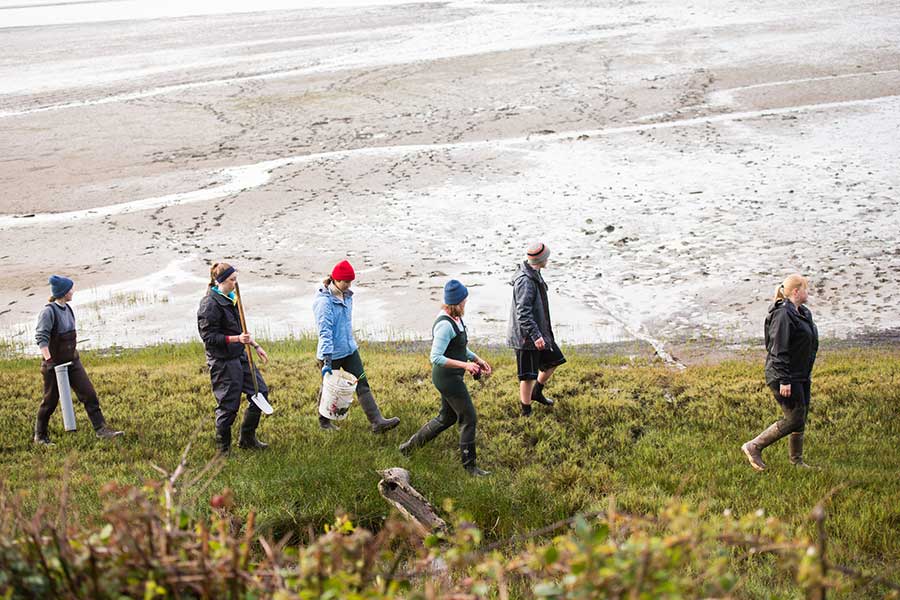
From left to right: Tiffany, Susana, Amanda and Noeila collecting data on oyster fishing in Oregon.

What
is Environmental Justice?
If we had to find one official definition of Environmental Justice it would be
defined by the EPA's Office as: "The fair treatment and meaningful
involvement of all people regardless of race, color, national origin, or income
with respect to the development, implementation, and enforcement of
environmental laws, regulations, and policies. Fair treatment means that no
group of people, including racial, ethnic, or socioeconomic group should bear a
disproportionate share of the negative environmental consequences resulting
from industrial, municipal, and commercial operations or the execution of
federal, state, local, and tribal programs and policies. All of our
stakeholders gave a different definition; we learned that there is not a right
or wrong answer to this question.Educating the Community
We have learned that there are large gaps between the local, state and federal government and the community. We need to learn how to fill these gaps with communication. Not every household has a telephone or access to the Internet. So we have to make an effort to educate the community about environmental issues that are occurring and we those who have concerns should be encouraged to speak up without a fear of retribution.Everyone has a voice and they want to be heard. There are several ways that we have learned to communicate with our community they are:
Ø Face to Face
Ø Talking to your neighbor
Ø Knocking on doors
Ø Attending community meetings
Ø Mailings / Flyers
Ø Internet
Ø
The goal of educating the community through education is to:
Ø Building trust in each other
Ø Creating life long friendships
Ø Developing leaders
Ø Getting the community involved in decisions that will affect them
Ø
We have learned that everyone has a voice and everyone wants to be heard. So we need to be effective and listen to everyone around us. While listening we need to be able to put our personal agendas and views aside and focus on the stakeholder.
Some key reminders for communication in listening:
Ø Preparing to listen
Ø Focus your attention on the speaker
Ø Attentive to posture
Ø Leaning forward in a relaxed but alert state
Ø Facing the speaker squarely
Ø Position yourself at an appropriate distance
Ø Body language
Ø Eye contact
Ø Sit up
Ø Limit distractions (cell phones)
Ø Sit in a circle not in rows
Ø Listen to what is being said and how it is being said
Ø Listen for content and meaning
Ø Pay attention to verbal and non-verbal cues
Ø Ask questions
Ø Never forget where you came from
Ø LISTEN = hearing and understanding
Ø
Websites that are relate to Environmental Justice:
Ø Portland Independent Media Center
Ø U.S. Environmental Protection Agency
Ø
Websites that were given by stakeholders:
Ø EJAG
Ø PACE-EH
Ø
Here are a few links that relate to education:
Ø Educating your community about anti-discrimination.
Ø The Oregon Environmental Council informs us on several environmental issues in Oregon.
Ø Education about the NJEP in Oregon.
Ø
We would like to thank to all of our stakeholders who gave up part of their day to help us learn about environmental justice.They included: Paul Barkley, Lani Roberts, Bob Zybach, Dave Hatch, Connie Kennedy, Fran Recht, Ron Eber, Kevin Odell, Charles Bishop, Peter Gutowsky, Jeri Sundaval, John Hayward, Carolyn Wesolek, Mayor Helen Berg, Steve Love, Sherry Pleu, Larry Venell, Teresa Hogue and Emery Castle.
Some memorial moments that our class will never forget:
Ø Where are the van keys? Kurt
Ø Are we done yet (with the long days)?
Ø Learning about all the different types of ‘folks’…fisher folk, farm folk, ect.