


History of Kappa Sigma

Bologna, Italy

Kappa Sigma's story begins in 14th century Italy with a man named Manuel Chrysoloras.  He was a statesman and scholar at the University of Bologna.  There were five students who considered themselves sons of Manuel Chrysoloras banded together with Chrysoloras and created Kappa Sigma to protect themselves against the corrupt governor of Bologna, Baldassarre Cossa.  They created secret signs and rituals to protect their brotherhood against infiltration by other individuals.

Through the Renaissance, tradition holds that Kappa Sigma existed at the other great universities of Europe. Although today there are student organizations at some European universities, which derive from those at Bologna, by the middle of the 19th Century, the Order was barely active. It was time for the tradition established by Chrysoloras and his disciples at the dawn of the Renaissance to reach America.

American Founding

In the mid-1800s, an American traveler in Europe was told by his noble host, “My colors fade . . . for want of wearers,” alluding to the inactivity of Kappa Sigma. From that charge to never allow Chrysoloras’s legacy to fade, Kappa Sigma came to North America.

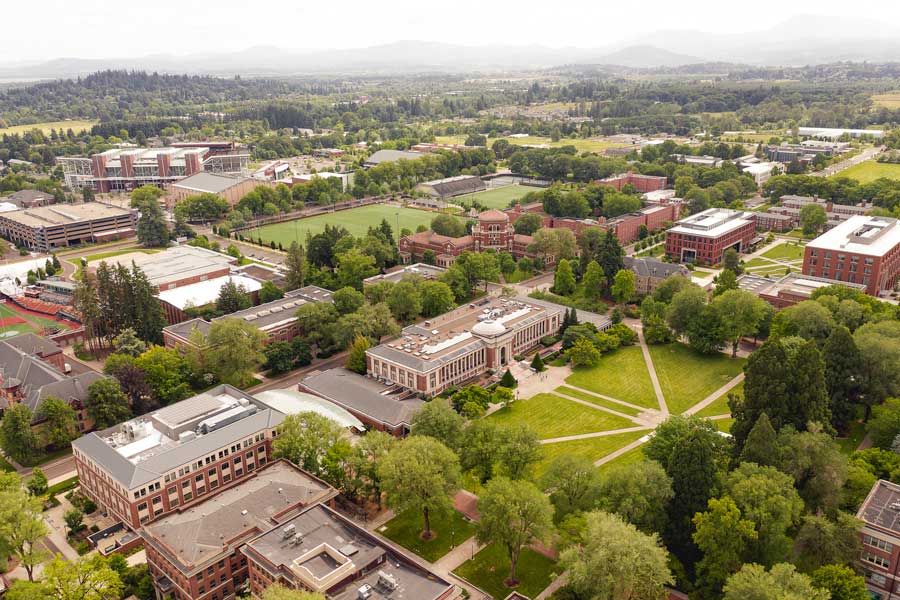
On December 10, 1869, five friends formed a chapter of Kappa Sigma at the University of Virginia.  This was the university that Thomas Jefferson designed several buildings for.  Since its founding, Kappa Sigma has spread throughout the nation, to eventually end up at Oregon State University in 1915.

Oregon Agricultural College


By the year 1905, Oregon Agricultural College had a student population of approximately 800 and was growing steadily. Fraternities were nonexistent at OAC, although some had been formed by this time in Eugene at the University of Oregon. Not to be outdone by their "sister" college, talk grew on the OAC campus of forming their own "Greek" system. out-of-state students and those who had attended eastern colleges encouraged this movement by telling how much Greek living added to campus life and activity at the nation's older and larger colleges. Eventually, these tales of the benefits and advantages of fraternity life reached an active group of nine young OAC men. These nine men had been close friends for some time--some longer than others, having been at OAC longer. All nine were good students and were close to the same age. They were not all members of the same class, however, and had different academic majors. It didn't take the group long to make it their goal to establish OAC's first fraternity. Each set out to find out as much as he could about how fraternities were established and operated.

To aid them in their "project" the group acquired the help of a member of the faculty -- Professor Lake, then head of OAC's Forestry Department. A fraternity man himself before coming to OAC, Professor Lake instructed the nine men as best he could in the "basics" of how fraternities were formed and maintained and about the necessity and importance of fraternity ritual and tradition.

Finally, on the rainy evening of April 13, 1905, at Professor Lake's invitation, the nine young friends met with him at his house and set down in writing the groundwork for what was to become OAC's first fraternity, Gamma Delta Phi. The full contents of the two original sheets of paper drawn up that night read as follows:

"we the undersigned nine students of the Oregon Agricultural College, having formed close friendship relations, feel in need of an organization by which these bonds of brotherhood can be strengthened thereby helping ourselves and all who may come under the influence of our circle, in the valuable lessons of our brotherhood.

Chief among these may be noted, aid by encouragement of students to put forth their best efforts to excel, first in their classes; second, in all students enterprises requiring high mental and physical development.

The method we have chosen to aid us in accomplishing the above named aims is the establishment of a local Greek Letter Fraternity modeled, as near as we can ascertain, after the best national fraternities of the country, with the hopes that some day our college will be blessed by a chapter of one of the large national fraternities.

The name of this fraternity shall be known as Gamma Delta Phi, and chapters named form letters or combinations of letters taken from the Greek alphabet such as the chapters may elect.

Our organization shall be secret; the officers shall be Presidents, Secretary, and Treasurer. Members of the fraternity shall be chosen from the four undergraduate classes of said OAC. unanimous ballot will be required to have any motion go into effect."

(Signed):
John A. Carlson (Senior in Engineering)
Ronald E . Esson (Senior in Pharmacy)
Merle V. Forrest (Left in June of '05 for Medical School)
Arthur E Belknap (Junior in Engineering)
D.R. Groves (junior in Forestry)
C.M. Stebinger (Sophomore in Agriculture)
Jens Lingaas (Sophomore in Forestry)
Earle P.W. Harding (Freshman in Pharmacy)
A.R. Barnett (Sophomore in Engineering)

Having founded OAC's first fraternity, the nine men unfortunately could find no accommodations suitable for "the group" so they continued to live separately but meet regularly. In 1910 the fraternity acquired the two upper floors of the large private residence of Doctor Farra. The accommodations did not include kitchen facilities, however so the members had to board around the neighborhood as best they could. While at Dr. Farra's. the men of Gamma Delta Phi made arrangements with then Presidents of the Corvallis State Bank, Mr. Thomas Whitehorn, for the building of the college's first fraternity house to be located on the corner of Eight and Van Buren streets. Mr. Whitehorn had the house built at his expense and the men moved into it on Thanksgiving Day 1911. The men at first rented the house from Mr. Whitehorn, but by 1921 the fraternity actually owned the house having paid a total of $17,000. (The house still stands at 239 North 8th Street.)

As stated in the original document, Gamma Delta Phi was not set up as a permanent fraternity. From the beginning, its members had hopes of someday affiliating themselves with one of the large national fraternities. Having acquired a house in the fall of 1911, that spring (1912) the fraternity voted to petition the then largest national fraternity, Kappa Sigma, for affiliation. The petition was sent the following year, but was refused on the grounds that Oregon Agricultural College did not meet the standards of the other major national colleges and universities. These standards were finally met in, however, in February 1914 when OAC raised entrance requirements from a three-year to a four-year high school course and moved to the full fifteen Carnegie unit basis--putting it on par, as far as the national fraternities were concerned, with Cornell, Pennsylvania, and the other major colleges. The raising of the college entrance requirements was good news not only to Gamma Delta Phi , but also to the other local fraternities and sororities which had also petitioned to various national organizations for affiliation. The following is a list of the other local organizations and the national organizations they were petitioning: (list includes only those existing in 1914)

Local Fraternities:

Gamma Delta Phi (founded spring 1905) ---- Kappa Sigma
Kappa Sigma Nu (founded fall 1906) ---- Phi Delta Theta
Delta Omega (founded spring 1909) ---- Sigma Alpha Epsilon
Gamma Upsilon (founded 1913) ---- Sigma Nu
Phi Delta Upsilon (founded 1914) ---- Sigma Chi

Local Sororities:

Alpha Chi ---- Kappa Alpha Theta
Alpha Omega ---- Alpha Chi Omega
Delta Me ---- Delta Zeta

The first of the above local organizations to become affiliated with a national fraternity was Delta Omega which received a charter with Sigma Alpha Epsilon in March 1915. Gamma Delta Phi followed shortly after with a charter from Kappa Sigma dated May 25th, 1915. Initiation ceremonies for the members of Gamma Delta Phi were conducted by the local Kappa Sigma alumni from the three-year-old Eugene chapter and the other available alums from the district (then district #17). The alumni initiated 17 men in two days-- June 4th and 5th, 1915.

(To be technically correct, it should be noted at this point that the first national fraternity at OAC was the Kappa Psi pharmacy fraternity, founded in 1910, but because this group eventually changed from a social to an honorary fraternity, it is not mentioned above.)

Of the twenty-seven men who had been initiated the previous spring, only sixteen returned to form OAC's new Kappa Sigma House the next fall. To make matters worse, rush that fall captured only six pledges.

In the spring of 1917, Gamma Sigma won kappa Sigma's District Scholarship Cup and was leading all other local OAC fraternities scholastically. By the end of that school year, however, there were only three members and two pledges left in the house. The others had gone to serve their country either in training camps or on the farms. World War I was underway.

Thirteen men returned to the house the following fall (1918) only to find the campus in a state of confusion. Because of the men in the area, the wartime conditions and the "overflow" of men into the area, the college was forced to make changes in living accommodations. Until the completion of the barracks--then under construction--men were placed in women's dormitories and in private homes throughout Corvallis. The armory was turned into a mess hall where 2,000 were fed, and the college took over the fraternity houses as halls for women. The Kappa Sig house was called Hall #7 and had 43 female occupants.

Forced to move and hoping to avoid the crowded dormitories, the Kappa Sigs moved under the leadership of then Grand Master Emil Seibert, moved into an upper floor of a private home at 302 north 12th. There they stayed for several months. Needless to say, athletics and campus activities were extremely limited at the time. The campus was continually being disrupted with sudden orders for certain combat units to "ship out." No man knew how long his stay in Corvallis would be. During this time, Kappa Sigma actives and alums could be found stationed in all parts of the United States and many served overseas.

By February 1919, however, the war was over, the students had returned, and college and fraternal social activities were being revived. The Kappa Sigs were able to return to their house . There were 30 men living in the house that spring, and almost all of them returned to the house the following fall (1919) as OAC's enrollment reached a record 3,000. The Kappa Sigs were very active in 1919--held many student body offices and important campus positions.

In March, 1925, the Kappa Sigmas were instrumental in starting and "pushing" a drive to raise funds for a new Memorial Union student center soon to be built at OAC.

In December, 1926, Kappa Sigma purchased a large lot directly across from the campus on Monroe Street (1/2 a block from the Phi Delta Theta house) for the site of a new house The following year when OAC officially became known as Oregon State College, the Kappa Sigs began some "money making projects" to raise funds for the new house. Unfortunately only a few hundred dollars was collected which was far from the $75,000 needed. Two years later architects were still working on the plans--(spring, 1929) the new house appeared far away.

On November 9, 1929, an article in the Oregon State Barometer read, "Fire, causing damage estimated at $2,000 broke out in the Kappa Sigma fraternity house yesterday afternoon at 2:45 o'clock and destroyed at least one study room and more than half of the roof of the building. no one was injured. . ." Almost exactly a year later a similar article appeared telling of another fire--one causing damage estimated at $3,500 (insured, of course). The Kappa Sigs had enough. With plans for the new house more or less complete, they sold the old house to the Kappa Psi fraternity and moved into a section of a men's dormitory. The original plans for the new house were "scratched" as being too expensive, new (revised) plans were drawn up, this time calling for a much smaller house (30-men capacity) three stories high, to be half timber and half brick at a cost of $50,000. May 15, 1931 was set for the "ground breaking" but was never held--the money just couldn't be raised.

In the fall of 1931 the Kappa Sigs moved into what is today called the Winston House on 26th Street across from Coed Cottage which was then the Alpha Chi Omega sorority house. The plans for the new house were not forgotten, however; some alumni were engaged in trying to secure a loan--many were unhappy with the "revised" plans and thought the house should be bigger.

In 1929, before the famous stock market crash, Tau Kappa Epsilon fraternity built a house on the corner of 25th and the Harrison streets. Following the stock market crash and the closing of many banks, Tau Kappa Epsilon was forced to give their house to bond holders and, became, as a result, inactive for a time at Oregon State. It so happened, however, that a Kappa Sig alum found out about this vacant house through his acquaintance with one of the bond holders.

During the summer of 1933, through some fancy high 'financial dealings," a group of Kappa Sigma alums were able to secure a lease on the then vacant "Teke" house for several years (the lease included furniture, dishes, etc., and a clause which provided for an option to buy at some later date.). So, the following fall (1933), the Kappa Sigs were on the move again--this time, they hoped, to a more permanent residence. The house was barely four years old when they moved in and since it had been vacant for two of those years, it was practically brand new. Its capacity was listed somewhere near forty so it was now up to the brothers to "Rush with all their might" to fill up their new home.

The Depression years were hard on colleges and fraternities--just as they were on everyone. Of the selected number who could afford to attend college during those years, still fewer could afford to pledge fraternities. The Kappa Sigma house was down in numbers like all the rest. Some fraternities, like Tau Kappa Epsilon, were even forced to become temporarily inactive.

Despite the financial difficulties, however, Kappa Sigma managed to hold its first "official" Barbary Coast Ball--celebrating the acquisition of their new home in the winter of 1934. In 1936 the upperclassmen built a "tub" in the basement of the new house. Although this original tub was subsequently "destroyed" by the underclassmen, its replacement was "solid" and, in fact was the largest and sturdiest of any "tub" on campus--not to be "removed" until the spring of 1961.

In 1938 Kappa Sigma accepted an option to buy the house they had occupied for $26,500 (including dishes, furniture, etc.) It was paid in eight years (by 1946) . Kappa Sigma held an impressive Anniversary Celebration in 1940 which lasted two days.

Somewhere between the years 1934 and 1940 a group of Kappa Sigma upperclassmen decided to form a sort of honorary within the house itself. They called themselves "The Shifters" and met secretly in the large closet just outside the dining room. The purpose of this "honorary" was to encourage the members the house to participate in campus activities. In order to belong to The Shifters one had to be a member of a varsity athletic team, be a class or student body officer or hold an important chairmanship or other campus position. The organization was evidently a success--its end is said to have come with the beginning of the second World War. Not only does the closet off the dining room now bear the name of this one-time organization, but the current tradition of pounding the table following the meals comes from this group. (Certain members used to pound the table at the close of a meal as a signal to the other "Shifters" that a meeting was to take place.)

With the beginning of World War II in December, 1941, the campus was once again involved in war-time activities. The enrollment at Oregon State, and total men staying at Kappa Sigma, were dependent on how many reserves--stationed at the colleges--were called to active duty. When most of the reserves were called (1943) Kappa Sigma was forced to "close down." The house was turned over to a private family who lived there for two years--school years '43- '44 and '44-'45. None of the fraternities had been able to remain active during those years--there just weren't enough college students--especially men.

With Japan's surrender and the end of the war, Oregon State's campus became swamped with ex-GI's. Kappa Sigma was one of the first four fraternities to re-activate that fall (1945). Due to the overflow of men and with the suddenly inadequate and overcrowded campus facilities and living quarters, Kappa Sigma was forced to make space available for several men who were in no way affiliated with the house. The "boarders," however, gradually found accommodations elsewhere and by spring only Kappa Sigmas occupied their house, although conditions were crowded--60 men living in a house built for 38 to 40. Although Oregon State began construction of several new buildings including apartments and dormitories in 1946, crowded conditions on campus were to last for at least two more years.

One winter's evening in December 1947, several members of the house were returning from a quick to Albany when they discovered an abandoned litter of five puppies along the road side. Returning to Corevallis, they gave two of the puppies to friends and kept three as mascots for the chapter house. They named the three pups after the establishment from which they returning that cold night, George, Don, and Bufford. Don was later renamed Donn-na as it seemed more appropriate. Unfortunately, Donna and Bufford lived exciting but short lives. George, however, lived on, becoming a Kappa Sigma tradition in his sloppy way. He lived twelve long years and during that time became known by almost everyone. George died in December 1959, without a successor.

In 1948 the Kappa Sigs were forced to do some remodeling and repair work on their overcrowded house. It was the first major repair work done since the house was built.

The early 1950's were very "prosperous" years for the Kappa Sigma. Several members held important campus positions including student body president and Barometer editor.

In the fall of 1955 the house held its Sorority Pledge Breakfast--inviting all the new freshman girls (sorority pledges) for a special waffle breakfast. The main purpose of the event, of course, was to get a good look at the "new crop." The event was so successful that it became an annual event and well known all over campus. The waffles were changed to pancakes in later years, however, to make things easier.

Also in 1955 Gamma Sigma of Kappa Sigma acquired its first house-mother--fraternity housemothers were suddenly required by a new university regulation. The Kappa Sigs chose an old acquaintance from the Alpha Phi sorority house across the street, the girl's former house- mother, Mrs. Rose Bonson. Although there were no regular housemother quarters available, the men converted what are now rooms #4 and #5 with the adjoining bath on the first floor into the new "housemother apartments."

As housemothers had been forced upon the men, they did not eagerly accept the idea. Many of the "old timers" who saw no usefulness in housemothers made Mrs. Bonson's life very unpleasant her first two years. Having had enough and feeling unwanted, Mrs. Bonson left the campus at the end of her second year to be replaced by the young and attractive Mrs. Lotta Mundt. Mrs. Mundt too, only stayed two years. The Kappa Sigs were evidently proving too much for any woman. So in the fall of 1959 the Kappa Sigs were once again without a house mother. They decided to offer the job once again to their original housemother, Mrs. Bonson. She accepted, to their delight and has remained with them ever since. A new apartment was built for her in 1961.

Talk began in 1958 and '59 concerning expansion of Kappa Sigma at Oregon State. Everyone was agreed that their present quarters were too small. An argument was to develop between two factions within he house., however, as to whether they should keep the old house and simply build a new addition or sell the old house and build a completely new house someplace else.

Arguments for both sides were strong. Chapter meetings became scenes of heated discussion. Eventually, however, it was decided that their present location was too good to lose. They would keep the old house and add a new addition. Construction finally got under way in the spring and summer of 1961. The Kappa Sigs were forced to look for temporary housing that spring term. Many went to dorms--those who were old enough and could afford it decided to live in off-campus apartments.

The new wing was completed and ready for occupancy in the fall of 1961 and each man was provided with a new lockable metal desk. The addition made Kappa Sigma the forth largest fraternity house at Oregon State.

In 1965 the Gamma Sigma chapter of Kappa Sigma celebrated its 50th anniversary with a banquet at the local Benton Hotel. Many alums were able to atend, and the celebration proved a success.

In the spring of 1967, another banquet was held, this time honoring retiring District Grand Master Emil Seibert, who, having been initiated in 1917, received recognition for 50 years service to the fraternity--both locally and nationally. Many prominent alumni were present, including Paul Harlan, editor o the CADUCEUS, the national fraternity magazine.

In March, 1967, two pledges found a small black and white puppy abandoned in a box in a local Laundromat at 4:00 one morning. They brought him to the house where he was made the official house mascot and given the name "Cossa." Unfortunately, as time went on Cossa's "visit" created mixed feelings among the brothers. As a result he was given to a family living on a large far, several miles from Corvallis. So it appeared, for the moment at least, that no dog could replace George.

As of yet, this is all the history that has been written. Obviously Mrs. Bonson is no longer our House Mom, and George has been replaced several times over. Unfortunately, the history hasn't been updated since since it was first written in 1967. Time permitting it will be updated and you the reader will have the pleasure of discovering why our house is haunted by the ghost of one of our house moms, when the glorious tradition of "chaining began" , who in fact replaced George, and many other important Earth Shaking Historical Facts.


About Us | Contact Us | ©2007 Kappa Sigma
Oregon State University Standard Disclaimer