


Vegetation
According to the 1936 State of Oregon Forest Type Map,54 which predates extensive logging, about one-third of the entire Blue Mountain Province was at that time primarily natural grasslands; about two-thirds was forested.
Natural grasslands (i.e., less than 10% natural shrub cover) occur sporadically throughout lower elevations of the Blue Mountain Province. They range in size from small openings and long narrow ridgetops in forested areas to extensive open grasslands. They extend along the entire northern province boundary from near Pilot Rock west to near Kinzua; in the vicinity of Ukiah, Starkey, LaGrande, and Elgin; and in central and northern Wallowa County from Wallowa–Enterprise–Joseph east and north past Findley Buttes and Zumwalt, including the breaks of the Snake, Imnaha, and Grande Ronde canyons. The grasslands near Findley Buttes are the highest native-forage-producing upland sites in eastern Oregon when in vigorous, high-ecological status. They probably are a model of what has been called the Palouse Prairie (Fig. 5).

Figure 5: Managed natural grasslands in Blue Mountain Province, Oregon
Essentially the same combination of plant communities and soil series occurs throughout these widely separated grasslands. This is due to the province-wide uniformity of soil parent materials and climatic conditions under which these soils and plant communities were formed.
On these natural grassland ecological sites, the basic perennial grasses are Idaho fescue, bluebunch wheatgrass, Sandberg bluegrass, and prairie junegrass. Big bluegrass, pinegrass, elk sedge, and timothy occur on more moist upland sites. Dry meadows produce a wide variety of species including Idaho fescue, sod bluegrasses, slender wheatgrass, thin bentgrass, California oatgrass, Columbia needlegrass, and threadleaf sedge. Wet meadows are typified by tufted hairgrass, redtop, slender wheatgrass, sod bluegrasses, baltic rush, Nebraska sedge, and red fescue.
Uniquely, in the lower reaches of the Snake and Imnaha canyons, which is the most arid portion of this province, there are small areas containing Fendlers threeawn. This is probably the only location in Oregon where it grows. Its major range is in the Great Plains. The oldtimer local ranchers called it “democrat” grass and claimed it did not show up until Franklin D. Roosevelt and the Democrats came into political power in the 1930s. Peck’s 1961 manual of higher plants of Oregon 23 cites it as being in these canyons. It is possible that the ranchers, having wintered livestock in the canyons for years, first noticed this grass when the severe drought of the 1930s diminished other forage species; coupled with intense winter grazing, this made the previously unnoticed threeawn appear prominent because it is apparently unpalatable when mature. How the species got there in the first place could be the basis for a campfire storytelling session: Nez Percé Indians returning from buffalo hunts in Montana? Explorer Frémont’s expedition was once lost in the Imnaha canyon?
Blue Mountain Province natural grassland sites are characterized by an abundance and wide variety of perennial forb species which make up 10 to 15% of natural plant communities on most sites.
Several low shrubs, such as low Oregon grape, wax currant, rose, common snowberry, green and gray rabbitbrushes, and herbaceous sage commonly occur in trace amounts in these natural grasslands. One distinctive feature of Blue Mountain Province is the overall scarcity of big sagebrush and other tall shrubs that dominate much rangeland in Oregon. Even on grasslands in deteriorated ecological status, shrubs do not become prominent in Blue Mountain Province. Rather, deteriorated grasslands are characterized by a dominance of perennial forbs, such as yarrow, gumweed, lupine, and biscuitroot and annual forbs and grasses. However, at least four species of the genus Artemisia occur in the province: big and stiff sagebrushes, tarragon, and lobed wormwood.
Along the line of demarcation between Blue Mountain and John Day provinces, both big sagebrush and western juniper, strongly characteristic of John Day Province, occur within the band or area where the two provinces join. This band of integrated vegetation is likely natural. However, it is also likely that characteristic John Day Province vegetation such as sagebrush and juniper have expanded into Blue Mountain Province due to severe grazing and timber harvest which degraded the vigor of original Blue Mountain plant communities, thereby allowing encroachment of John Day woody species. Expansion of Blue Mountain vegetation south into the John Day Province is not likely because the climate becomes abruptly more arid on the John Day side of the line. Ecological invasion more often occurs from arid to more moist situations.
Three major kinds of natural shrub–grassland (i.e., 10% or more natural shrub cover) occur in Blue Mountain Province. The most common is the site locally called scabland. The vegetation on this very shallow, very stony site is dominated by Sandberg bluegrass. Bluebunch wheatgrass, Idaho fescue, and a few other perennial grass species occur sparsely between the surface stones. Perennial forbs, such as Hooker balsamroot, biscuitroot, big-head clover, bitterroot, onion, and snow buckwheat are prominent. Stiff sagebrush is the dominant shrub; however, an occasional rose or common snowberry may occur.
An entirely different kind of natural shrub–grassland occurs on very steep north-facing areas within the elevation range of natural grasslands. These areas represent snowdrift pockets which receive moisture beyond normal precipitation. The vegetation is dominated by shrubs such as common snowberry, rose, chokecherry, hawthorn, mockorange, and ninebark. An occasional ponderosa pine or Douglas-fir may occur. The understory is dominated by Idaho fescue along with such grasses as timothy, oniongrass, Kentucky bluegrass, Columbia needlegrass, pinegrass, mountain brome, bluebunch wheatgrass, and an abundance of perennial forb species.
Bottomlands along major streams, where soils are usually gravelly, produce woody vegetation along with meadow vegetation. Water flowing through the gravelly soils is aerated, and woody species such as cottonwoods, some willow species, alder, birch, and ponderosa pine are capable of flourishing in spite of seasonal or periodic high-water tables or overflow. The understory vegetation varies widely according to the frequency and duration of soil water; the plant communities range from dry meadow to wet meadow species, usually occurring in patches.
Coniferous forest occupies most of Blue Mountain Province. These forests represent five generalized plant communities (with transition from warm to cool to cold forest), each with management implications.
1. Ponderosa pine with understory dominated by Idaho fescue, bluebunch wheatgrass, many forb species, and shrub species with pine reproduction. A warm forest.
2. Ponderosa pine with understory dominated by pinegrass, elk sedge, Idaho fescue, bluebunch wheatgrass, many forb species, and many shrub species with pine reproduction.
3. Mixed ponderosa pine, Douglas-fir, some grand fir and some larch with an understory consisting of pinegrass, elk sedge, Idaho fescue, other shade-tolerant grass and forb species, and many shrub species with pine and Douglas-fir reproduction. A cool forest. (Fig. 6).

Figure 6: Typical pine-fir-pinegrass forest in Blue Mountain Province, Oregon
4. Mixed grand fir, Douglas-fir, larch, lodgepole pine, and Engelmann spruce with sparse understory of shade-tolerant grass and forb species mainly in openings, shade-tolerant shrubs, and much grand fir and Douglas-fir reproduction.
5. Subalpine fir, larch, lodgepole pine, and Engelmann spruce with a sparse understory of shade- tolerant forbs and shrubs. A cold forest.
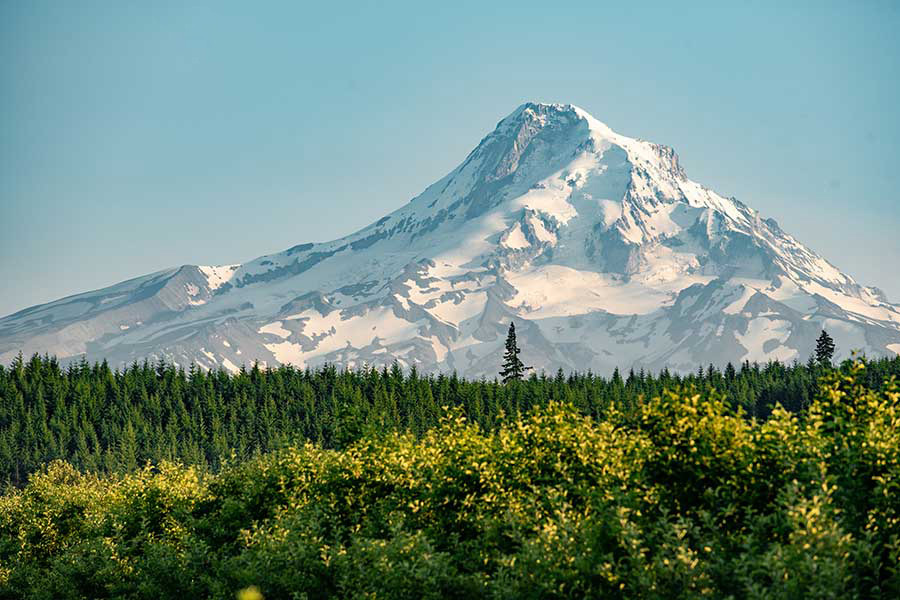
Subalpine areas consist of a variety of plant communities which contain species such as whitebark pine; subalpine fir; elk, Ross, and Hood sedges; green and Idaho fescues; yarrow; fleeceflower; and mountain big sagebrush. These are not coniferous forests. Rather, they are patchy patterns of various plant communities (Fig. 7).

Figure ;7: Looking south from Hawkins Pass, which is the source of South Fork Imnaha River in Blue Mountain Province, Oregon
The different kinds of soils that help differentiate Blue Mountain Province from John Day Province are supported by significant differences in the site-specific plant communities. For example, the ponderosa pine–bunchgrass ecological site occurs in both provinces and, based on casual observation, they resemble each other: pine trees, shrubs, grasses, forbs. However, numerous samples of this ecological site in both provinces reveal significant differences in the species that constitute the plant community of the site. In Blue Mountain Province, the following species regularly occur but are rarely, if ever, found on this site in John Day Province: Kentucky bluegrass, onespike oatgrass, threadleaf sedge, huckleberry, mockorange, and herbaceous sage. On the other hand, the following species regularly occur on this site in John Day Province but are rarely, if ever, found on this site in Blue Mountain Province: Wheeler bluegrass, Thurber needlegrass, Ross sedge, mountain snowberry, curlleaf mountain-mahogany, green rabbitbrush, big sagebrush, and western juniper. Obviously, these differences are not readily apparent within the belt of demarcation between these provinces but are apparent in provincewide data.
Even greater differences occur on the ponderosa pine–sedge ecological site in each of the provinces. The following species regularly occur in Blue Mountain Province but rarely, if ever, are found on this site in John Day Province: slender wheatgrass, timber oatgrass, western fescue, Columbia needlegrass, threadleaf sedge, blue wildrye, slender hairgrass, deerbrush, elderberry, spirea, ninebark, huckleberry, serviceberry, dogbane, syringa, chokecherry, bitter cherry, oceanspray, bearberry, and herbaceous sage. The following species regularly occur on this site in John Day Province but rarely, if ever, on this site in Blue Mountain Province: basin wildrye, Wheeler bluegrass, mountain snowberry, curlleaf mountain mahogany, green rabbitbrush, big sagebrush, and western juniper.
Generally, Blue Mountain Province forested-site plant communities consist of more numerous species than those in John Day Province. This is especially noticeable in the shrub component. The reason might relate to the soils and climate of Blue Mountain Province as compared to those of John Day Province.
A study of the geographic distribution of major plant species within Oregon, based on their occurrence within specific ecological provinces and on specific ecological sites, would be a worthwhile contribution to coming generations of resource scientists and managers who are increasingly required to set goals and objectives for various ecological situations.