Nicole von Germeten

Associate Professor
325B Milam Hall
Corvallis, OR 97331
Phone: (541) 737-9564
Fax: (541) 737-1257
Email: nicole.vongermeten@oregonstate.edu
Dr. von Germeten teaches courses in Latin American and Spanish history.
Background
Von Germeten received her PhD from the University of California Berkeley in 2003 and was a Fellow at the Princeton Center for the Study of Religion in 2003 and 2004. She also has an MA in Spanish language literature and wrote a thesis on Sor Juana Ines de la Cruz's use of indigenous Mexican language and religion.
Prof. von Germeten was affiliated with the Stanford University Center for Latin American Studies in 2008 and 2009. She has contributed essays, reviews and articles to several edited volumes and journals, including Black Mexico, Studies in Eighteenth-Century Culture, Colonial Latin American Historical Review, and Local Religion in Colonial Mexico.
Select Publications
|
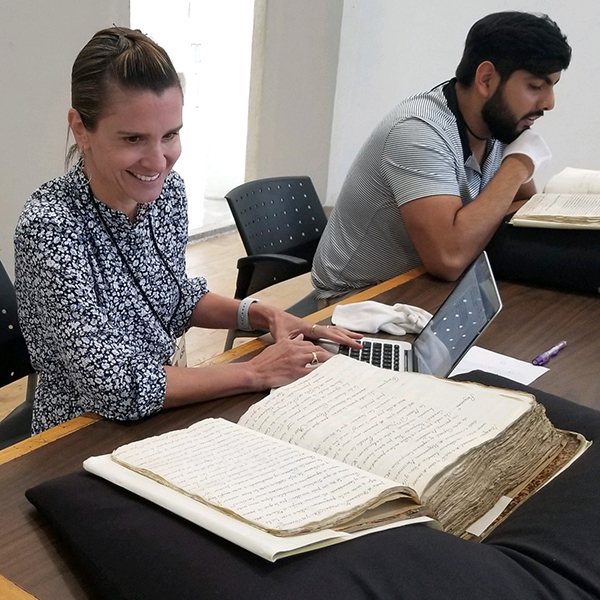
Her first book, Black Blood Brothers, based on work in more than 20 Mexican archives, describes the social and religious life of Africans in Mexico, using documentation from more than 60 Afromexican brotherhoods.
University Press of Florida; 1st edition |
![]() |
![]() |
Her second book is a translation of Alonso de Sandoval's 1627 guide for missionaries working with African slaves in colonial Colombia, titled De Instauranda Aethiopum Salute. Hackett Pub Co (March 14, 2008)
|
The University of New Mexico Press will publish Dr. von Germeten's third book Violent Delights, Violent Ends: Sex, Honor, and Witchcraft in Colonial Colombia in 2013.
'Women in colonial Cartagena de Indias took control of their own sex lives and used sex and rhetoric connected to sexuality to help themselves when they had to negotiate with colonial bureaucrats. Cartagena women could be sexually assertive but they also had to be acutely aware of the danger inherent to disregarding the restricted, highly judgmental take on female sexuality set by Counter Reformation Catholicism and the Hispanic honor code. They also used love magic, a mix of indigenous, African, Creole, and European ingredients and methods. If these secret sexual machinations and use of spells and potions turned into a public scandal, domestic slaves became extremely useful witnesses in a criminal or inquisitorial investigation.
Women who stepped outside the bounds of marital sex also risked aggressive male litigious posturing and threats of violence in line with the Hispanic honor code. In this book, women support the honor code but are not always victims of it. We will see a continuous push and pull dynamic of men asserting honor while women struggle for sexual agency and attempt effective litigating techniques. While men frequently presented themselves as full of righteous anger sparked by slights to their honor, women were more likely to play the role of sexual victims. Both roles were purposefully designed to favorably advance litigation, but this book strives to analyze these court cases by going deeper than simply trusting the stories told before judges. For colonial women, sexuality was a competitive, tense, and vibrant part of their lives, while for men, anger and violence played a more prominent role in the self presented to the courts. A persona based on sexual aggressiveness was more common and acceptable for men, but men did not have a monopoly on sexual agency.'